When Coffee Meets Humidity: Measuring Instant Coffee Flowability with the PowderPro X1
2026-11-02News
Instant coffee is sold on convenience: a spoonful, hot water, and a consistent cup every time. Behind that simplicity is a demanding powder handling problem. Before it reaches the consumer, instant coffee powder must move reliably through silos, transfer lines, dosing units and packaging machines. When its flowability changes, every one of those steps becomes harder to control.
Humidity is one factor that can significantly affect powder flowability. In our latest application video, Bettersize application engineer Viola demonstrates how relative humidity (RH) affects instant coffee powder flowability, and how the PowderPro X1 quantifies the shift using the Carr Index Method. Below, we walk through the test and what the results mean.
Why Humidity Changes Instant Coffee Powder Flow
Instant coffee is a hygroscopic food powder. It readily takes up moisture from the surrounding air, and that moisture strengthens the interactions between particles. The result is a more cohesive powder bed that resists free flow.
Under relatively dry conditions, instant coffee may exhibit better flowability. As humidity rises, the same material can start to bridge, cake and compact unevenly. This creates practical risks across the production chain:
- Storage: cohesive powder is more likely to form arches or rat-holes in hoppers and silos.
- Transportation: vibration during transfer and shipping can densify a moisture-affected powder bed.
- Dosing and packaging: less predictable flow leads to fill-weight variation and line stoppages.
The challenge is that these changes often begin before processing starts. Quantifying them requires measurements that are tied to the actual environmental conditions at the time of testing.
Measuring Coffee Powder Flowability with the PowderPro X1
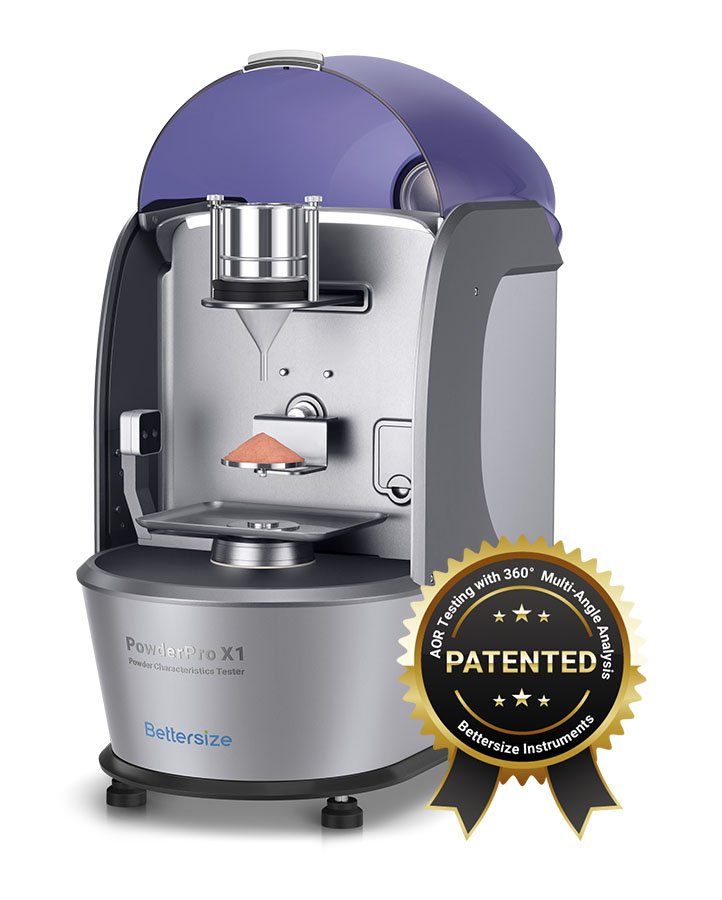
The PowderPro X1 is an automated powder characterization system that evaluates up to 18 powder properties and supports more than 20 international standards, including USP, Ph. Eur., ISO and ASTM. Built-in temperature and humidity monitoring links every result to the conditions it was measured under.
In the video, commercial instant coffee powder is tested under two humidity conditions, 25 °C / 40% RH and 25 °C / 65% RH. Each run follows the same four-step sequence:
- Angle of repose: powder is poured through a funnel to form a pile, and the system performs 360° multi-angle imaging and analysis of the powder pile , rather than a single profile.
- Angle of spatula: reflects how strongly the powder adheres during lifting, mixing and feeding.
- Bulk and tapped density: bulk density is measured in a glass cylinder before the instrument switches to tap mode. From the two values, the software calculates compressibility automatically.
- Cohesion: sieve retention is measured to determine Carr's cohesion, the tendency of particles to stick together or agglomerate.
Once both conditions are tested, the software calculates a Flowability Index and generates a separate evaluation report for each.
Interpreting the Results with the Carr Index Method
Raising humidity from 40% to 65% RH lowered the Flowability Index of instant coffee powder from 74 ("Good") to 66 ("Normal"). The Carr Index Method converts each measured parameter into an index score, then sums those scores into a single Flowability Index, so reports from different conditions can be compared directly.
|
Parameter |
25 °C / 40% RH |
25 °C / 65% RH |
|
Angle of repose (°) |
44.27 |
47.43 |
|
Angle of spatula (°) |
20.71 |
25.85 |
|
Compressibility (%) |
13.51 |
17.07 |
|
Cohesion (%) |
25.2 |
26.4 |
|
Flowability Index |
74 (Good) |
66 (Normal) |
The angle measurements showed the clearest shift. Higher angles of repose and spatula indicate greater resistance to particle movement. Compressibility increased as the difference between bulk and tapped density became more pronounced, indicating a greater tendency for the powder to consolidate under tapping. Cohesion increased slightly, consistent with moisture strengthening interparticle forces.
No single parameter tells the whole story. By combining multiple measurements, Carr's method offers a broader assessment of how powder flowability responds to environmental changes.
What This Means for Food Powder Manufacturers
An eight-point drop in Flowability Index suggests a potential increase in powder-handling challenges. As the video previews at its close, humidity also changes dynamic behavior. In a follow-up study on the same samples, flow rate at 65% RH through a 2.5 mm Hall funnel fell from 5.62 g/s to 4.18 g/s, extending the discharge time for 50 g by around 34%. Dispersibility also fell, from 9.11% to 6.84%.
For quality control and process teams, environment-linked flowability data supports:
- Setting storage limits: supporting the evaluation of suitable humidity limits before flow performance degrades.
- Optimizing processing conditions: adjusting hopper design, feeding and dosing settings for seasonal or regional humidity.
- Tracing deviations: connecting batch-to-batch variation back to the conditions at the time of testing.
- Material selection: comparing formulations or suppliers under identical, recorded conditions.
The same principle applies well beyond coffee. Milk powders, creamers, sugars, flavorings and other moisture-sensitive food powders can all change behavior during long storage or transport.
Turn Humidity from a Hidden Variable into Measured Data
Humidity can quietly turn a free-flowing instant coffee powder into a less predictable processing material. By combining Carr Index flowability testing with automatic temperature and humidity monitoring, the PowderPro X1 makes those changes visible, comparable and traceable.
Want to see how your powders respond to humidity? Watch the full demonstration video, read the application notes on coffee and humidity and coffee in motion, or send us your sample through our free sample testing service.
|
|
PowderPro X1 18-in-1 Powder Characteristics Tester
|
Rate this article
Share On


Recent News