Abstract
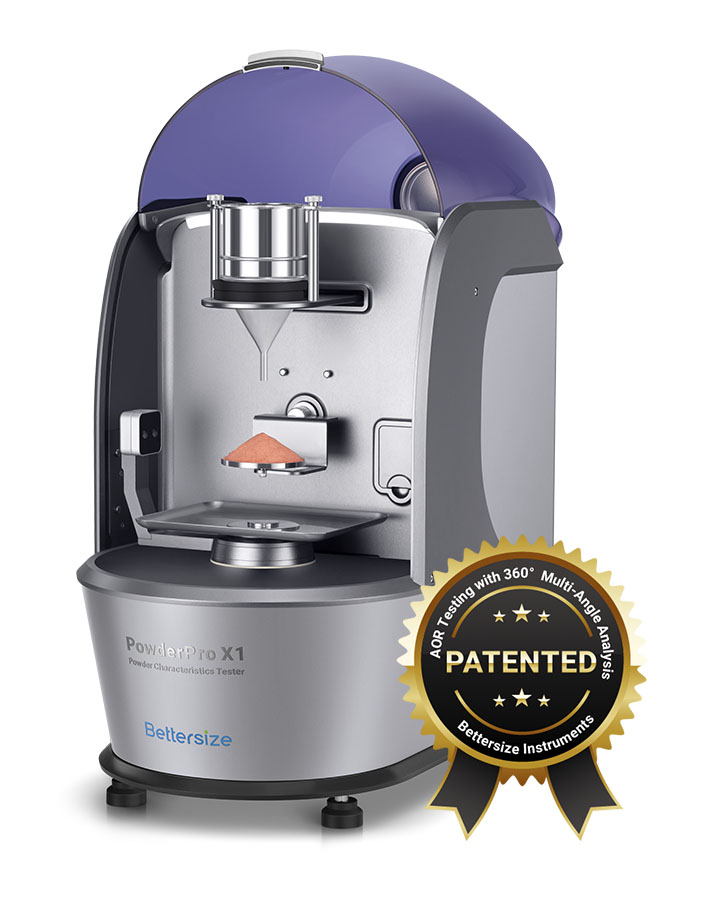
Instant coffee powder typically flows well under dry conditions but can exhibit significantly different behavior as humidity increases. In this application note, PowderPro X1 was used to evaluate the flowability of instant coffee powder under two environmental conditions: 25 °C / 40% RH and 25 °C / 65% RH. Using the Carr Index Method, the results revealed a clear decline in powder flowability under higher humidity conditions, indicating that moisture alters the powder’s inherent flow characteristics before processing begins. By combining comprehensive powder characterization with built-in temperature and humidity monitoring, PowderPro X1 enables direct linkage between powder behavior and environmental conditions, making moisture-related flowability changes easier to quantify, compare, and trace.
Keywords
Instant coffee powder; Carr Index Method; Humidity; Flowability; Angle of repose; Compressibility; Food powder
|
Product
|
|
|
Industry
|
|
|
Sample
|
Instant coffee powder
|
|
Measurement Type
|
|
|
Measurement Technology
|
Introduction
Instant coffee is expected to dissolve quickly and deliver a consistent flavor experience. Before it reaches the consumer’s cup, the powder must first flow reliably through storage, transfer, dosing, and packaging operations. Reliable powder flowability is therefore essential for maintaining process efficiency and product quality.
As a moisture-sensitive food powder, instant coffee readily absorbs moisture from the environment. Increased moisture can strengthen interparticle interactions, causing particles to become more cohesive and less flowable. These changes may affect the material’s handling characteristics and increase the risk of process variability.
To quantify these changes, PowderPro X1 evaluates powder flowability using the Carr Index Method, which combines multiple physical parameters, including angle of repose, compressibility, angle of spatula, and density-related parameters, into a comprehensive flowability assessment. Built-in temperature and humidity monitoring ensures that test results remain directly associated with actual environmental conditions.
In this study, instant coffee powder was tested under 25 °C / 40% RH and 25 °C / 65% RH conditions to evaluate how humidity affects its overall flow characteristics, as reflected by changes in flowability-related parameters.
Instrument and Materials
Instrument
PowderPro X1 is a next-generation powder characterization system developed by Bettersize. Combining automated testing with modular hardware architecture, the system evaluates up to 18 core powder properties and quantifies powder flowability based on the Carr Index Method. The instrument integrates measurements such as Angle of Repose, Compressibility, Angle of Spatula, and Cohesion. Compatible with more than 20 international standards, including USP, Ph. Eur., ISO, and ASTM, PowderPro X1 supports powder characterization across R&D, quality control, process optimization, and regulatory applications.
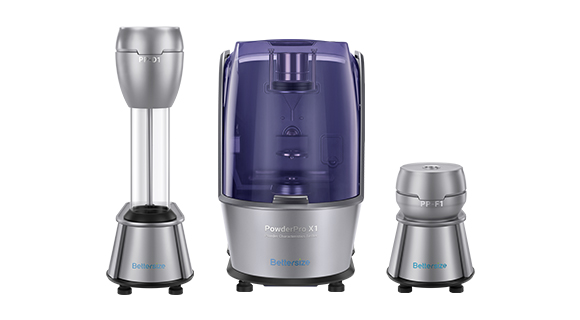
PowderPro X1
Sample
Commercial instant coffee powder was used as the test sample.
Environmental Conditions
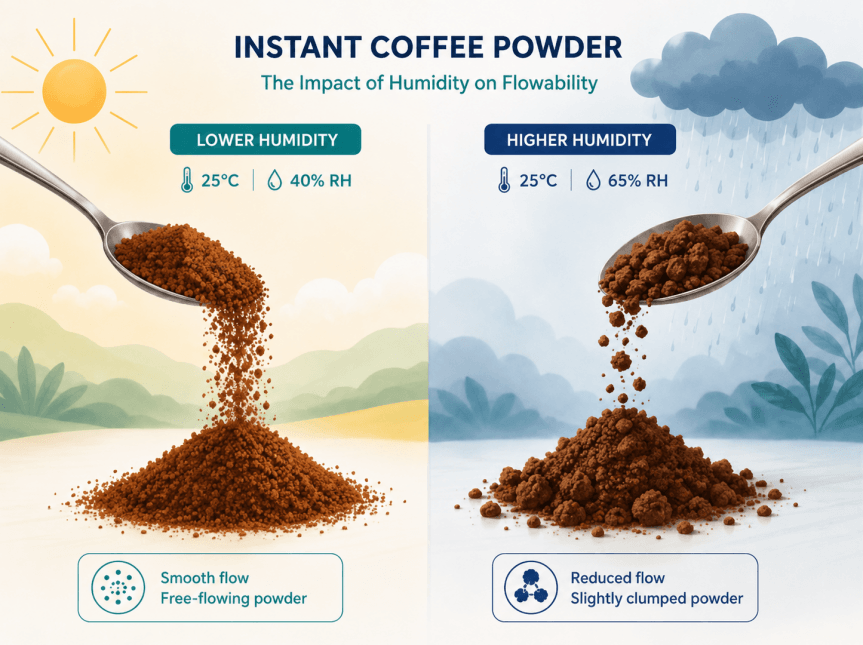
Two environmental conditions were selected for comparison:
- 25 °C / 40% RH: lower-humidity condition
- 25 °C / 65% RH: higher-humidity condition
Test Parameters
The following Flowability-Related Parameters were measured: Angle of Repose, Angle of Spatula, Bulk Density, Tapped Density, Compressibility, Cohesion, and Flowability Index.
These parameters collectively describe powder packing behavior, flow resistance, and overall flowability based on the Carr Index Method.
Results and Discussion
Table 1. Flowability-Related Parameters of Instant Coffee Powder under Different Humidity Conditions
|
25℃ 40%RH |
25℃ 65%RH |
|||
|---|---|---|---|---|
|
Test Value |
Index |
Test Value |
Index |
|
|
Angle of repose(°) |
44.27 |
16 |
47.43 |
12 |
|
Angle of spatula(°) |
20.71 |
25 |
25.85 |
24 |
|
Tapped density(g/cm3) |
0.37 |
/ |
0.41 |
/ |
|
Bulk density (g/cm3) |
0.32 |
/ |
0.34 |
/ |
|
Compressibility(%) |
13.51 |
21 |
17.07 |
18 |
|
Cohesion(%) |
25.2 |
12 |
26.4 |
12 |
|
Evaluation of Flowability |
||||
|
Flowability Index |
74 |
66 |
||
|
Evaluation |
Good |
Normal |
||
At 25 °C / 40% RH, the instant coffee powder achieved a Flowability Index of 74, corresponding to a “Good” flowability rating. When the relative humidity increased from 40% RH to 65% RH, the Flowability Index decreased to 66, and the rating shifted to “Normal.” This decline indicates that increased humidity altered the powder’s overall state, resulting in reduced mobility and less predictable flow behavior during handling.
The most significant changes were observed in the angle measurements, which are closely related to powder mobility and flow resistance. The Angle of Repose increased from 44.27° to 47.43°, while the angle of spatula increased from 20.71° to 25.85°. Higher angle values generally indicate greater resistance to particle movement and poorer flowability. The increase in angle values suggests that moisture reduced the ability of the powder to flow freely, potentially leading to less stable transfer and discharge behavior during processing.
Compressibility is calculated from bulk density and tapped density, reflecting how easily the powder bed compacts after tapping. A larger density difference indicates greater void space and stronger packing tendency under vibration.
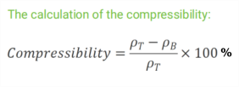
Compressibility provides insight into powder packing behavior. The compressibility increased from 13.51% to 17.07% as humidity increased, indicating a greater tendency for particle rearrangement and packing. These results suggest that moisture altered the packing characteristics of the instant coffee powder, making the powder bed less stable and more prone to density variations during handling.
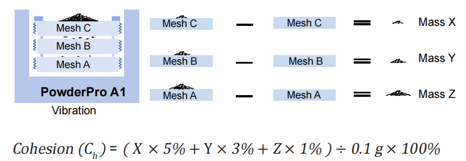
Cohesion is calculated according to the Carr Index Method using sieve retention data and reflects the tendency of particles to adhere to one another or form agglomerates. In this study, cohesion increased slightly from 25.2% to 26.4% under the higher humidity condition. This observation is consistent with the increase in angle measurements and compressibility, further supporting the conclusion that moisture strengthened particle interactions within the powder bed.
Overall, the results show that humidity does not simply affect a single parameter; it influences the overall flow behavior of the powder. The increases in angle-related values, higher compressibility, and stronger cohesion indicate reduced powder mobility, altered packing behavior, and enhanced interparticle interactions, which together led to lower overall flowability and greater handling risks. These changes resulted in a lower Flowability Index and a transition from Good to Normal flowability, indicating a higher risk of handling and processing variability under elevated humidity conditions.
Conclusion
The impact of humidity is not limited to instant coffee powder. Many food powders and other moisture-sensitive materials, especially those stored or transported over long periods, may gradually absorb moisture, which can change their flow behavior as they interact with the surrounding environment.
Using instant coffee powder as a practical example, this study shows how environmental humidity can turn a familiar material into a less predictable processing variable. The decrease in the Flowability Index from 74 to 66 shows that humidity-induced changes can be quantified through objective measurements of powder flow behavior.
By combining Carr Index-based flowability data with automatic temperature and humidity monitoring, PowderPro X1 enables users to detect subtle changes in powder characteristics, compare material performance under different environmental conditions, and trace flowability variations back to actual testing conditions.
This integrated approach provides valuable support for material selection, storage optimization, process development, and quality control, helping manufacturers better manage moisture-related risks throughout the product lifecycle.
About the Author
 |
Feiqing Shen Application Engineer @ Bettersize Instruments |
|
|
PowderPro X1 18-in-1 Powder Characteristics Tester
|