

- ● What is Molecular Size?
- ● Related Instruments
Among the many parameters used to describe molecular size, the radius of gyration (Rg) is one of the most commonly used. Rg is defined as the mass-weighted average distance from the center of mass of a molecule to each of its mass elements, providing information about the molecular size and conformation in solution. In light scattering measurements, Rg indicates whether a molecule behaves as a small, compact structure or a large, extended one.
When the molecular size exceeds a certain threshold, scattering becomes angle-dependent, and low-angle light scattering is required for accurate analysis. By combining low-angle and right-angle light scattering signals, both absolute molecular weight and Rg can be determined, offering deeper insight into molecular structure beyond molecular weight alone.
Related Instruments
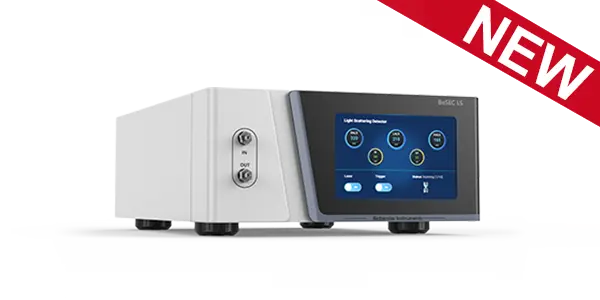
BeSEC
Light Scattering Detector for SEC/GPC Systems
Dual detection angles: 7° and 90°
Molecular weight range: 1 kDa to 2 GDa
Supports radius of gyration Rg > 12 nm