Series positioning
This application note builds upon the humidity-based flowability study of the same instant coffee powder. While the first study focused on static flowability evaluation under different humidity conditions, this study extends the assessment to dynamic powder behavior, including dispersibility, floodability, and outlet flow rate.
Abstract
Instant coffee powder may exhibit acceptable static flowability, yet its behavior during dynamic discharge, dosing, and packaging can still vary significantly under different environmental conditions.
In this application note, PowderPro X1 was used to further evaluate the same instant coffee powder samples tested at 25 °C / 40% RH and 25 °C / 65% RH. By combining dispersibility, floodability, and flow rate measurements, the study revealed that increasing humidity reduced the Floodability Index from 60 to 56.75 and decreased the flow rate measured through a 2.5 mm Hall funnel from 5.62 g/s to 4.18 g/s.
These results indicate that humidity influences not only whether a powder can flow, but also how steadily and predictably it behaves during process-related operations. The study highlights the importance of evaluating dynamic powder behavior in addition to conventional flowability measurements.
Keywords: Instant coffee powder; Dispersibility; Flow rate; Floodability; Dynamic flow behavior; Food powder; PowderPro X1
|
Product
|
|
|
Industry
|
|
|
Sample
|
Instant coffee powder
|
|
Measurement Type
|
|
|
Measurement Technology
|
Introduction
In the previous study, instant coffee powder was evaluated under two humidity conditions to investigate the effect of moisture on overall powder flowability. When relative humidity increased from 40% RH to 65% RH, the Flowability Index decreased from 74 to 66, and the flowability classification changed from “Good” to “Normal.” These results indicated that higher humidity altered the powder characteristics, making its flow behavior less predictable during handling.
In practical production environments, such changes can directly affect how powders discharge from hoppers, pass through outlets, feed into packaging lines, and fill containers. While flowability provides an overall assessment of powder behavior, additional parameters are often required to understand how powders respond under dynamic movement and handling conditions.
Floodability evaluates the tendency of a powder to become aerated, dispersed, or unstable during handling. Flow rate directly measures how efficiently powder passes through a defined outlet. Together with dispersibility, these parameters provide a more comprehensive understanding of powder performance during dynamic processing operations.
In this study, the same instant coffee powder was evaluated at 25 °C / 40% RH and 25 °C / 65% RH using PowderPro X1. Dispersibility, floodability, and flow rate measurements were performed to investigate how humidity affects dynamic powder behavior and outlet discharge performance.
Instrument and Materials
Instrument
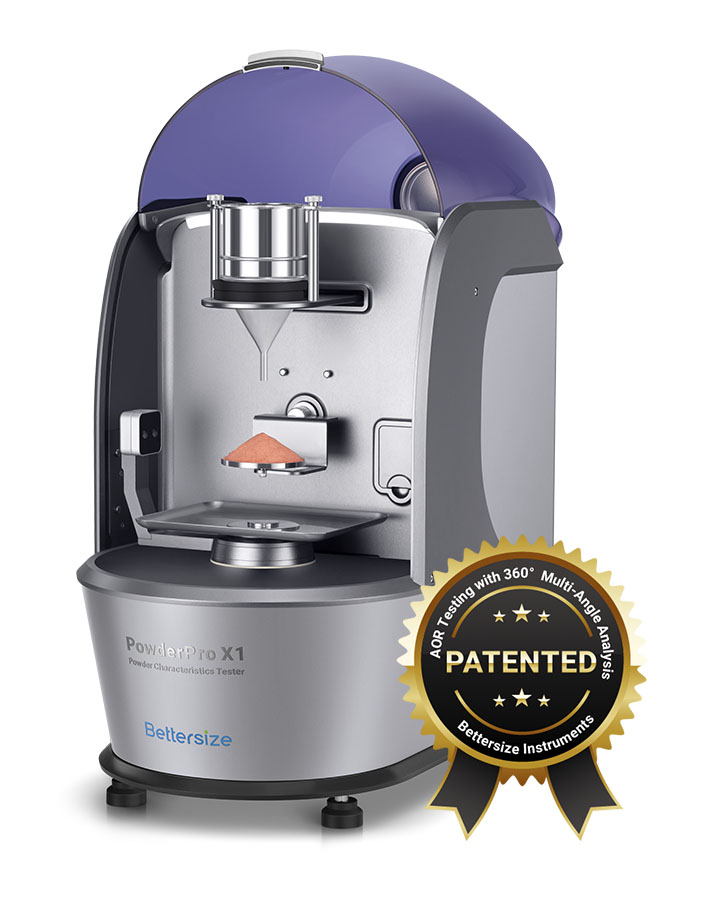
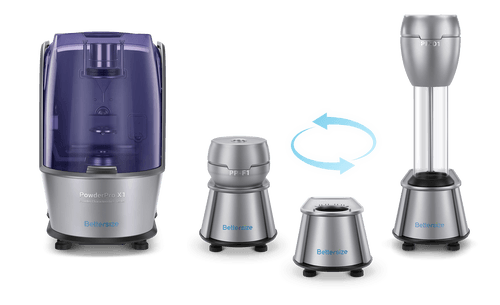
PowderPro X1 is a next-generation powder characterization system developed by Bettersize. In addition to comprehensive powder flowability evaluation based on the Carr Index Method, the system can be configured with dedicated modules for dynamic powder behavior evaluation, including dispersibility and flow rate measurements.
|
Configuration |
Purpose |
Value in this study |
|---|---|---|
|
PP-D1 Dispersibility |
Evaluates the degree to which a powder disperses after free-falling through a defined test path. |
Identifies changes in dispersion behavior caused by humidity. |
|
PP-F1 Flow Rate |
Measures powder discharge through a selected funnel outlet with real-time mass recording. |
Quantifies discharge speed and outlet flow continuity. |
Both test units are built on a common base with an integrated weighing system, allowing users to quickly switch between tests while evaluating multiple aspects of powder behavior using a single instrument.
Sample
Commercial instant coffee powder was used as the test sample.
Environmental Conditions
- 25 °C / 40% RH: lower-humidity condition
- 25 °C / 65% RH: higher-humidity condition
Test Parameters
- The Carr Index Method was used to evaluate floodability based on the following parameters: Angle of Fall, Angle of Difference, Dispersibility, Flowability Index, and Floodability Index.
| Evaluation Logic of Carr Index Method |
|
Measure Key parameters
|
| Flowability index, angle of fall, angle of difference, and dispersibility |
| ↓ |
|
Convert to index Scores
|
| Use the chart on the right to convert each value into an index score |
| ↓ |
|
Sum indices
|
| A higher total index indicates stronger floodability / flushing tendency |
- Flow rate was determined by measuring the discharge rate of 50 g of instant coffee powder through a 2.5 mm Hall funnel outlet, with real-time mass recording throughout the test.
Results and Discussion
1. Floodability Evaluation
|
Test Item |
25 °C / 40% RHTest Value |
Index |
25 °C / 65% RHTest Value |
Index |
|---|---|---|---|---|
|
Angle of Fall (°) |
35.64 |
16 |
38.75 |
16 |
|
Angle of Difference (°) |
8.63 |
9.5 |
8.68 |
9.5 |
|
Dispersibility (%) |
9.11 |
9.5 |
6.84 |
6.25 |
|
Flowability Index |
74 |
25 |
66 |
25 |
|
Floodability Index |
60 |
/ |
56.75 |
/ |
|
Evaluation |
Fairly high |
/ |
Tends to flush |
/ |
|
Measures for Flushing Prevention |
Rotary seal is required |
/ |
Sometimes rotary seal is required |
/ |
The Floodability Index decreased from 60 at 25 °C / 40% RH to 56.75 at 25 °C / 65% RH, with the evaluation shifting from “Fairly High” to “Tends to Flush.” In this context, it is important to distinguish floodability from flow rate. Floodability reflects a powder’s tendency to become aerated, dispersed, or prone to unstable flow during motion, while flow rate directly describes the speed at which powder passes through a defined outlet.
The angle of fall increased from 35.64° to 38.75°, while the angle of difference remained nearly unchanged, changing from 8.63° to 8.68°. These results suggest that the higher-humidity sample formed a steeper powder profile after collapse, although its relative collapse behavior did not change dramatically.
The most significant difference was observed in dispersibility. When relative humidity increased from 40% RH to 65% RH, dispersibility decreased from 9.11% to 6.84%, and the corresponding index score decreased from 9.5 to 6.25.
This reduction indicates that the humid sample became less likely to disperse freely after movement. A likely explanation is that absorbed moisture increased interparticle attraction and promoted slight particle agglomeration, reducing the powder’s ability to separate into individual particles during dynamic motion.
Overall, the results suggest that elevated humidity altered the powder’s dynamic behavior, making the material less dispersible and changing its floodability characteristics. These effects may influence handling performance in operations such as conveying, hopper discharge, dosing, and packaging.
2. Flow Rate Evaluation
|
Test Item |
25 °C / 40% RH |
25 °C / 65% RH |
Change |
|---|---|---|---|
|
Flow Rate |
5.62 g/s |
4.18 g/s |
Decreased |
|
Calculated Discharge Time for 50 g |
8.90 s |
11.96 s |
Increased |
The flow rate decreased from 5.62 g/s under 40% RH to 4.18 g/s under 65% RH, indicating that the powder discharged more slowly under higher-humidity conditions. For a 50 g sample, the corresponding discharge time increased from approximately 8.90 s to 11.96 s, representing an increase of about 34%.
This result suggests that moisture reduced the powder’s ability to move efficiently through the 2.5 mm Hall funnel outlet. A likely explanation is that increased humidity strengthened interparticle interactions, resulting in greater resistance to particle movement during discharge.
The flow rate results are consistent with the trends observed in the previous flowability study. Higher humidity led to higher angle values, increased compressibility, and a lower Flowability Index, all of which indicate reduced powder mobility. The slower discharge rate observed here provides direct evidence that these changes can translate into measurable differences in outlet flow performance. From a processing perspective, a lower flow rate may indicate the risk of slower hopper discharge, reduced feeding efficiency, inconsistent filling performance, and greater variability in dosing and packaging operations.
3. Combined Interpretation: From Static Flowability to Dynamic Discharge
|
Observation |
25 °C / 40% RH |
25 °C / 65% RH |
Meaning |
|---|---|---|---|
|
Static flowability |
Flowability Index = 74; Good |
Flowability Index 66; Normal |
Higher humidity reduced overall flowability. |
|
Floodability |
Index = 60; Fairly high |
Index 56.75; Tends to flush |
Dynamic flow behavior became more sensitive to handling conditions. |
|
Dispersibility |
9.11% |
6.84% |
Humid powder reduced the powder’s ability to disperse less. |
|
Flow rate |
5.62 g/s |
4.18 g/s |
Higher humidity powder slowed powder discharged through the Hall funnel. |
The combined results show that static flowability, floodability, dispersibility, and flow rate should be interpreted as complementary indicators rather than as isolated measurements.
The previous flowability study showed that increasing humidity reduced the overall Flowability Index from 74 to 66, indicating a decline in overall powder handling performance. The present study further reveals that the same humidity increase reduced dispersibility and slowed discharge through a narrow outlet, providing additional insight into how the powder behaves during dynamic processing.
This distinction is important because powders with similar static flowability characteristics may perform differently during actual handling operations. A powder that appears acceptable based on conventional flowability measurements may still exhibit process-related challenges such as unstable hopper discharge, fluctuating feed rates, localized blockage or bridging, or filling variation.
By combining PP-D1 dispersibility testing and PP-F1 Flow Rate measurement, PowderPro X1 extends powder characterization beyond the question of “Can the powder flow?” to address the more practical question of “Can the powder flow steadily, continuously, and predictably?”
Because both test modules share a common base platform and integrated weighing system, dispersibility and discharge behavior can be evaluated within a consistent measurement framework. This enables more direct comparisons between different aspects of powder performance and generates results that are more relevant to real processing conditions.
Conclusion
This study extends the previous humidity-based flowability evaluation of instant coffee powder to include dynamic powder behavior testing.Under the higher-humidity condition, instant coffee powder showed lower dispersibility, a reduced Floodability Index, and a reduced flow rate through the Hall funnel. These findings indicate that humidity affects not only the overall flowability of instant coffee powder, but also its behavior during conveying, dosing, and discharge operations.
For moisture-sensitive food powders, evaluating both static and dynamic behavior provides a more complete understanding of processing performance. By linking Carr Index-based flowability data with Floodability, dispersibility, and flow rate measurements, PowderPro X1 helps identify handling risks that may not be apparent from a single test method.
This integrated approach enables manufacturers to better assess whether a powder can flow steadily, continuously, and predictably under real-world processing conditions, supporting improved process control, product consistency, and operational reliability