Wet Dispersion for Particle Size Analysis: From Medium Selection to Sampling and Cleaning
2026-10-14News
Laser diffraction particle size analysis depends not only on the instrument, but also on the condition of the sample as it enters the measurement zone. Agglomeration, dissolution, or nonrepresentative sampling can cause the measured particle size distribution to differ from the sample’s original state. Wet dispersion is about choosing a suitable medium, finding the right dispersion conditions, and keeping sampling and measurement as consistent as possible.
Choose a suitable dispersion medium
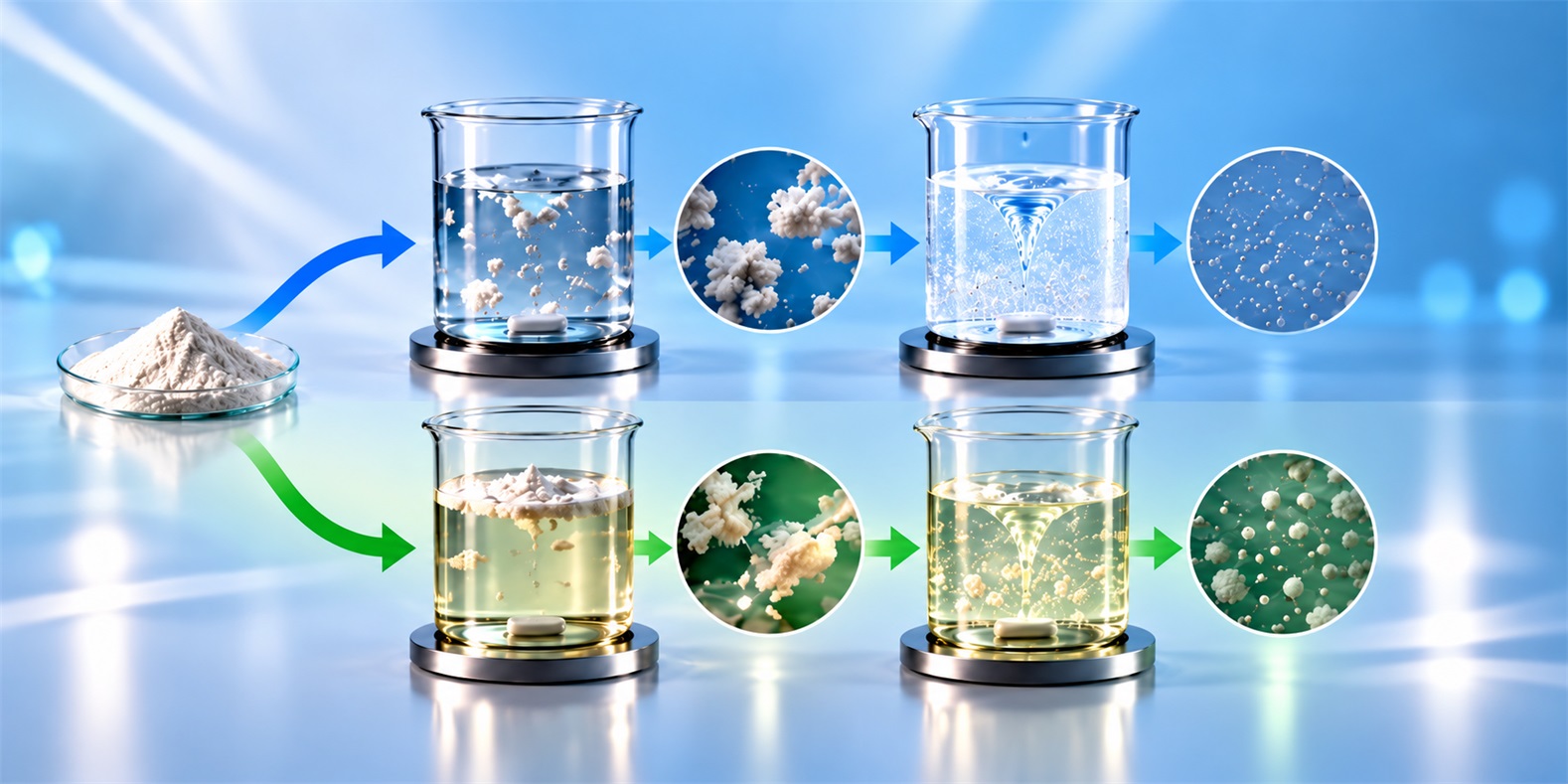
Start by considering how the sample behaves in a liquid. Can the particles be wetted? Will they dissolve or swell? Can they remain suspended? Deionized water may be evaluated for hydrophilic powders. For hydrophobic samples, compare water and alcohol-based media based on wetting and dispersion behavior. Medium compatibility affects the measurement, so also confirm that the instrument’s wetted flow path is suitable for the selected liquid.
If agglomerates remain after stirring, evaluate whether a dispersant would help by comparing its effect on the suspension and the measurement results. The type and concentration of dispersant should be determined for the sample; a single formulation should not be applied to all powders.
Increase dispersion energy step by step
Begin with stirring, then decide whether to use ultrasound based on the sample’s condition. The goal is to break up agglomerates while leaving the particles themselves as unchanged as possible. Longer sonication or higher energy does not necessarily produce more reliable results. Observe the results and temperature as you adjust the conditions to suit the sample.
Laser diffraction also requires appropriate optical parameters. Before testing, enter suitable refractive index and absorption values for the particles and dispersion medium. These inputs are used to calculate the particle size distribution, so use values from reliable material information or a validated method.
Sample and load carefully, and watch for changes
Add the sample slowly along the vessel wall to reduce foaming. Homogenize the sample before taking an aliquot and transfer it as completely as possible to help ensure that it represents the bulk material. For samples that settle quickly, control the time between mixing and measurement.
Once measurement begins, watch whether obscuration remains stable. A drifting reading may indicate dissolution, swelling, or another change in sample condition; investigate it in the context of the material. Medium choice and measurement timing are especially important for water-soluble or swelling samples. Shortening the wait after dispersion, or evaluating a different medium or dispersion method, can help reduce interference from changes in sample condition.
Set quality criteria for the method
Obscuration and the repeatability of D10, D50, and D90 can all help check the measurement process. Appropriate acceptance ranges, however, depend on the sample, method, and laboratory quality requirements. Fix the medium, dispersion steps, sampling approach, and measurement conditions first, then establish acceptance criteria for the target sample. This gives batch comparisons a consistent basis.
For routine quality control, a validated method needs to be easy to repeat. The Bettersizer series supports saving and recalling dispersion parameters and workflows for both dry and wet methods through SOPs, helping laboratories incorporate established methods into more consistent daily operation. Dispersion conditions should still be optimized for each sample.
Clean promptly after measurement
Rinse the sample cell and flow path promptly after measurement to reduce dried residue and carryover into the next test. When using volatile or flammable solvents, ensure good ventilation. Before using a special solvent, confirm its compatibility with the instrument’s wetted materials and the cleaning procedure.
There is no single wet dispersion recipe for every sample. By validating and repeating a complete workflow for medium selection, dispersion, sampling, and cleaning, laboratories can generate particle size data that are more useful for routine comparison and quality control.
Frequently asked questions
What medium should I use for wet particle size analysis?
Consider whether the sample can be wetted, whether it will dissolve or swell, and whether it can remain suspended. Then select a medium compatible with the instrument’s flow path. Water and alcohol-based media are possible starting points; the final choice depends on the sample and test method.
When should I add a dispersant?
If the medium and stirring do not produce a suitable dispersion, evaluate a dispersant. Compare its effect on the sample condition and measurement results to identify a suitable type and concentration for that sample.
Does longer sonication always improve dispersion?
No. Ultrasound can help break up agglomerates, but it should not alter the particles themselves. Adjust sonication gradually and monitor the results and temperature to find suitable conditions for the sample.
How can I improve sampling representativeness?
Homogenize the sample before sampling, minimize settling, and transfer the aliquot as completely as possible. For samples that settle quickly, also control the time between mixing and measurement.
What does drifting obscuration mean?
It may indicate that the sample condition is changing, for example through dissolution or swelling. Investigate the cause in context, considering the material, medium, and loading process rather than relying on a single reading.
Can the same repeatability limits be used for every sample?
No. Repeatability criteria should match the sample, test method, and laboratory quality requirements, and should be established through method validation with the target sample.
|
FURTHER READING / Lab Tips Want to explore further? Check our labtips for more! Read the Original →Lab Tips |
 |
Rate this article
Share On


Recent News