How Does Laser Diffraction Compare GCC Particle Size Distributions? A Three-Sample Calcium Carbonate Case Study
2026-10-12News
Ground calcium carbonate (GCC) is used in many industrial products, each with its own particle-size requirements. D10, D50, D90, and the full particle size distribution (PSD) curve help laboratory users compare size fractions and batches against specifications. This article uses laser diffraction data from three GCC samples to explain what these measures show.
Why Measure GCC Particle Size Distribution?
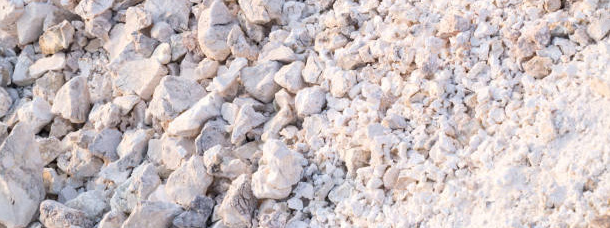
GCC is produced by crushing and grinding natural calcite and is used in paints, paper, adhesives, and concrete. Particle size measurement helps compare powders and monitor classification quality and stability.
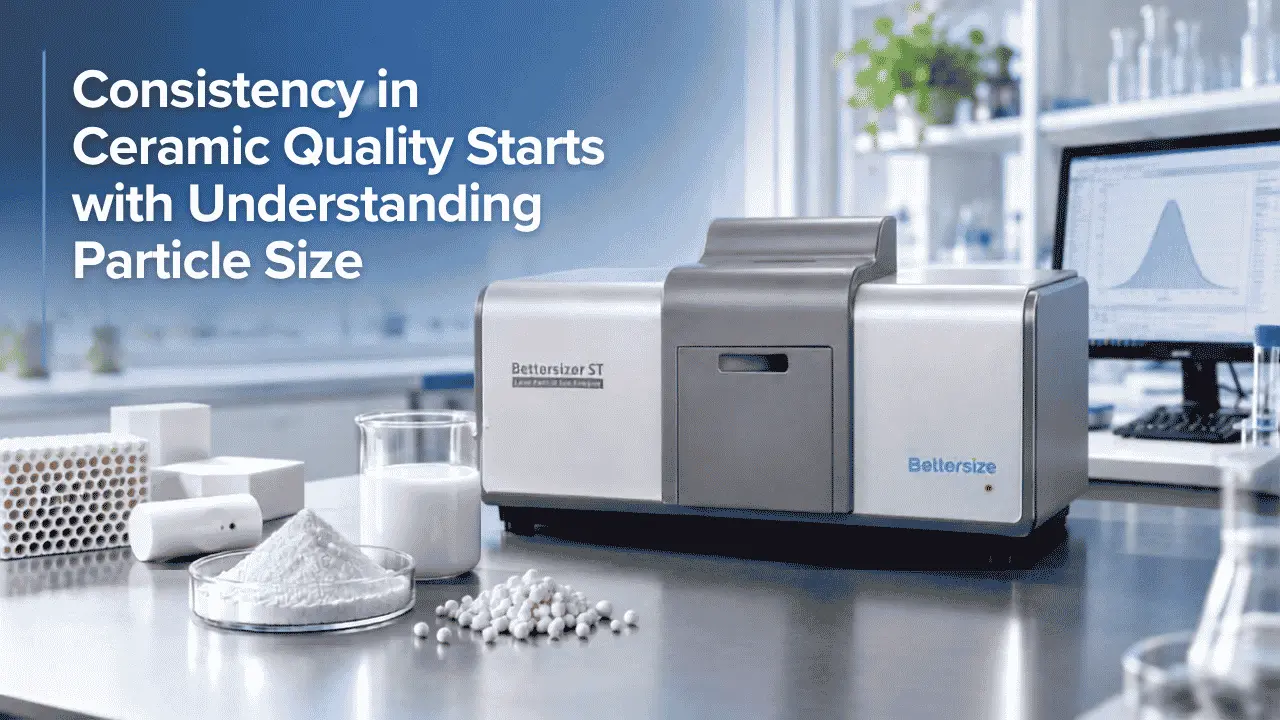
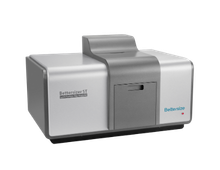
Three classified and packaged GCC samples (A, B, and C) were measured on Bettersizer ST using its integrated wet dispersion unit. Each sample was measured six times.
|
|
|
|
Bettersizer ST |
white calcites and GCC powders |
How Should D10, D50, and D90 Be Interpreted?
D10, D50, and D90 are the particle sizes at which the cumulative distribution reaches 10%, 50%, and 90%, respectively. D50 is the median; D10 and D90 describe the finer and coarser ends. The full PSD curve shows the distribution’s overall shape.
Results for the three samples (μm):
- Sample A: D10 2.290; D50 16.14; D90 35.61
- Sample B: D10 2.289; D50 16.07; D90 36.54
- Sample C: D10 2.095; D50 15.78; D90 34.79
The values are broadly similar. Sample C has slightly lower D50 and D90, indicating a smaller median size and coarse-end percentile.
Can Laser Diffraction D90 Fully Replace 325-Mesh Sieving?
Not completely. With suitable dispersion and method settings, laser diffraction measures scattered light to derive a high-resolution, continuous, smooth PSD curve that characterizes the particle population. D90 is the size at which 90% of the cumulative distribution is reached. It is an important coarse-end control metric, but it is not the actual amount above 45 μm or the sieve residue.
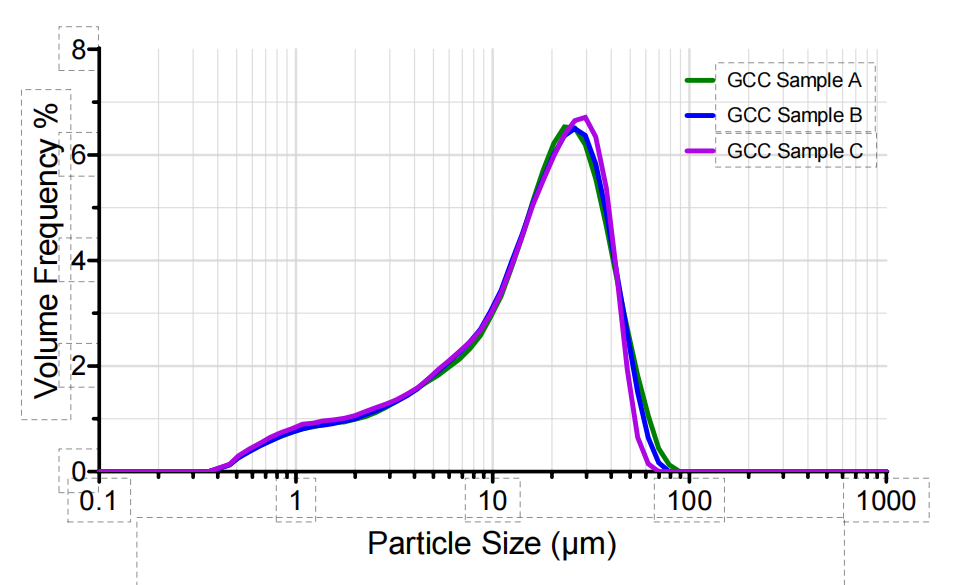
PSD curves of GCC samples A, B, and C
A 325-mesh sieve has a nominal aperture of about 45 μm and physically retains and separates oversize particles. It is useful when coarse particles must be removed or acceptance is based on sieve residue. Sieving yields separated fractions but has lower particle-size resolution than a continuous PSD. Laser diffraction is non-contact and cannot physically separate or remove particles above 45 μm. Therefore, D90 cannot fully replace sieving: use laser diffraction to monitor the overall PSD and screening to confirm or remove oversize material.
What Do the Repeat Measurements Show?
Across six repeat measurements of Sample C, reported repeatability errors for D10, D50, and D90 were 0.32%, 0.85%, and 0.25%, respectively. All three were below 1% in this series, showing repeat-measurement performance for this GCC sample.
How Can Particle Size Data Support Quality Control?
Laser diffraction is widely used in industry and laboratories. ISO 13320:2020 provides guidance for laser diffraction measurement, while ASTM E3340 describes method development for powder materials and its use in quality control. For GCC, D10, D50, D90, and the full PSD curve can help track size-fraction and batch changes against product specifications.
Frequently Asked Questions
Why shouldn’t I rely on D50 alone?
D50 gives the median only; it does not show the finer and coarser ends. Review it with D10, D90, the full PSD curve, and product specifications.
Why is dispersion important in wet laser diffraction?
Agglomeration can affect results. Choose a dispersion medium and procedure suited to the sample, then keep them consistent after validation.
Can laser diffraction be used for GCC quality control?
Yes, when sampling and measurement procedures are established for the product specifications. Use D10, D50, D90, and the full PSD curve to track particle-size changes and batches.
References
How Are Particles Dispersed When Using the Wet Method? — Bettersize Wiki
ISO 13320:2020 — Particle size analysis — Laser diffraction methods
|
FURTHER READING / APPLICATION NOTE Want to explore this study further? Read the original application note for the full experimental methods, data, and findings. Read the Original →GCC Powders · Laser Diffraction · Particle Size Distribution |
 |
Rate this article
Share On


Recent News