A Quick Guide to Analysing Food Stability with the BeScan Lab+
2026-07-21News
Developing a stable food formulation often involves balancing dozens of interacting ingredients, each capable of influencing long-term product performance. A food system that appears homogeneous at the start may gradually separate, aggregate, or reorganise during storage. Detecting these changes early can significantly accelerate formulation development and reduce costly trial-and-error testing. The BeScan Lab+ stands as a powerful tool for monitoring structural evolution, helping food researchers assess stability at a level that extends beyond routine visual inspection.
Introducing the BeScan Lab+: A Window into Dispersion Stability
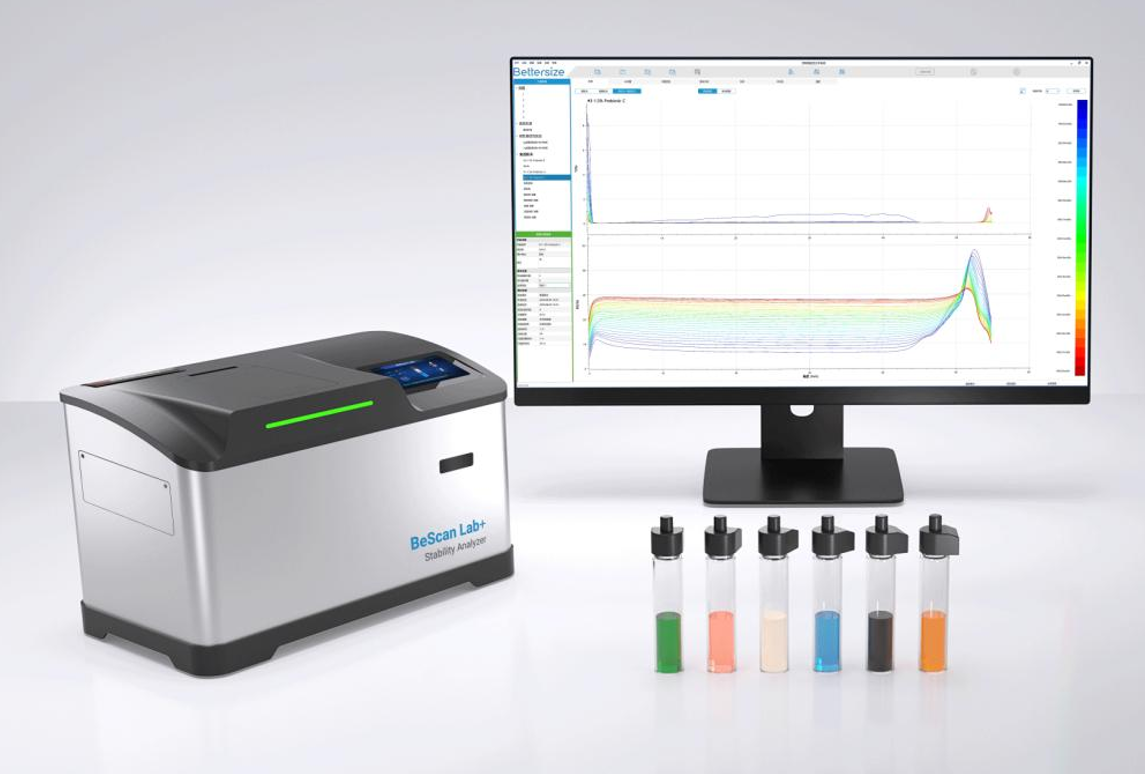
Food dispersions often present a challenge for stability analysis. High particle concentrations, optical opacity, and complex ingredient interactions can limit the effectiveness of conventional measurement techniques like microscopy and particle size analysis following dilution.
The BeScan Lab+ addresses such obstacles, providing direct insight into destabilisation processes within products such as plant-based beverages, sauces, dairy alternatives, and emulsions. It works by using Static Multiple Light Scattering (SMLS) technology. Once measurement begins, near-infrared light scans the full height of the sample while detectors track transmitted and backscattered signals. This approach produces an optical profile along the full sample height, indicating changes in particle or droplet size and spatial distribution. Samples containing up to 95% volume fraction can be examined in their original concentration range, delivering stability data that closely reflects actual formulation behaviour
Undertaking Food Stability Analysis With The BeScan Lab+
|
1
|
Isolating the Food Sample in Its Native StateAccurate stability analysis begins with preserving the formulation exactly as it exists before testing. Additional preparation steps can alter the interactions between proteins, fats, stabilisers, and other ingredients, making it harder to understand how a product will behave in storage. For that reason, the BeScan workflow offers a straightforward preparation procedure. The operator should load the sample into a compatible measurement cell using a procedure that minimises air bubbles, shear, and temperature changes. Where the native sample is suitable for measurement, testing can be performed without dilution or added reagents. Preserving the original structure ensures that droplets, suspended particles, and ingredient networks remain undisturbed throughout the test. As a result, the collected data reflects the formulation itself rather than changes introduced during preparation. |
|
2
|
Configuring Environmental Parameters for Accelerated Stability TestingTemperature often determines how quickly structural changes emerge when conducting stability analysis of a food system. Instead of waiting through lengthy storage studies, researchers can accelerate these processes under controlled laboratory conditions using the BeScan Lab+. Testing parameters can be tailored to the product under investigation with the BeScan Lab+'s software interface. The integrated temperature chamber operates at temperatures up to 80°C, enabling faster comparison of formulation responses under controlled thermal stress than conventional shelf studies.. Faster access to stability information helps development teams compare ingredient combinations, assess stabiliser performance, and refine formulations more efficiently. Laboratories working with multiple candidates can further improve productivity through independent multi-channel testing, which supports the simultaneous evaluation of up to 10 samples under different conditions. |
|
3
|
Activating the SMLS Scan to Map Microscopic MovementWith testing conditions established, the stability analysis enters its measurement phase. Inside the BeScan Lab+, an optical scanning head travels vertically along the sample cell, collecting measurement points every 20 microns. By moving through the entire sample height, the analyser generates a detailed map of the formulation and records how its structure changes over time. Two complementary signals contribute to this analysis. Transmission measurements are most informative when sufficient light passes through the sample, while backscattering measurements are particularly useful for highly scattering or optically opaque dispersions. Together, these signals reveal changes in particle distribution, droplet organisation, and concentration throughout the sample. Characteristic shifts in the optical profile also reveal processes such as creaming, sedimentation, aggregation, and phase separation, helping to pinpoint where changes occur and how they progress during testing. |
|
4
|
Translating BeScan Data into Actionable Formulation FixesGraphical outputs formed during stability analysis connect observed changes with specific destabilisation mechanisms. Signal variations near the top or bottom of the sample typically indicate particle migration. Activity near the upper region often corresponds to creaming, and accumulation near the bottom suggests sedimentation. In contrast, changes occurring within the middle of the sample are more commonly associated with particle size evolution, including flocculation, aggregation, or coalescence. Alongside such visual profiles, the software calculates an Instability Index (IUS), which condenses complex light-scattering data into a single quantitative value. Under the same measurement protocol, formulations with smaller structural changes generally show lower or more slowly increasing IUS values, whereas less stable systems tend to show faster increases.. This straightforward metric makes it easier to compare formulations, rank candidates, and support development decisions with objective data. |
Unlocking Deeper Insight into Food Stability
The BeScan Lab+ can help food scientists perform stability analysis without compromising sample integrity. By combining SMLS technology with accelerated testing capabilities and intuitive data analysis, the BeScan Lab+ provides a structured approach to evaluating concentrated food dispersions and emulsions. Contact Bettersize Instruments today to explore how the BeScan Lab+can enhance your stability testing capabilities, reveal subtle structural changes, and provide objective data for formulation development, ingredient selection, and quality assurance.
Rate this article
Share On


Recent News