The Ultimate Guide to the Best Systems for Nanoparticle Size Analysis
2026-09-23News
Nanoparticle size analysis encompasses samples ranging from proteins and pharmaceutical formulations to pigments, coatings, and battery materials. Variations in concentration, optical properties, stability, and particle size distribution can place very different demands on measurements. An effective nanoparticle analyzer should accommodate variations across sample types while providing complementary characterization capabilities when particle size alone cannot provide the information required.
Core Technologies to Look for in a Nanoparticle System
Dynamic light scattering (DLS) is widely used for nanoparticle size analysis because it measures particles directly in dispersion. Suspended particles undergo random Brownian motion, causing fluctuations in scattered-light intensity. Analysis of those fluctuations delivers a translational diffusion coefficient, which can be converted into hydrodynamic diameter using the Stokes-Einstein equation.
Optical geometry plays an important role in DLS performance. Conventional 90° detection can provide valuable measurements, but 173° backscattering can be particularly useful for concentrated or strongly scattering dispersions. By detecting scattered light in the backward direction, the measurement can use a shorter optical path through the sample, helping to reduce the effects of multiple scattering. When combined with adjustable measurement positioning, this geometry can also accommodate a wider range of sample concentrations with less reliance on dilution.
Electrophoretic light scattering (ELS) provides another analytical dimension by measuring electrophoretic mobility, from which zeta potential can be determined. Zeta potential describes electrostatic interactions at the particle-liquid interface and provides important information for assessing colloidal stability.
Phase Analysis Light Scattering (PALS) extends zeta potential measurement to challenging conditions through detecting small phase shifts associated with particle motion. This high sensitivity enables the measurement of low electrophoretic mobilities, including those encountered near a particle's isoelectric point, where its zeta potential approaches zero.
Modern laboratories frequently need more insights than particle diameter and zeta potential. Static light scattering (SLS) supports molecular weight determination, DLS microrheology investigates microscopic rheological behavior, and liquid refractive index (RI), particle concentration, and transmittance measurements add further physical information to provide a more complete picture of the sample.
BeNano Series: Tailored Nanoparticle Size Analysis
Bettersize Instruments has developed the BeNano series for laboratories needing multi-parameter characterization within a compact platform. Different configurations incorporate DLS, ELS, SLS, and transmission-based techniques, allowing laboratories to match analytical capabilities with specific research, formulation development, and quality control requirements.
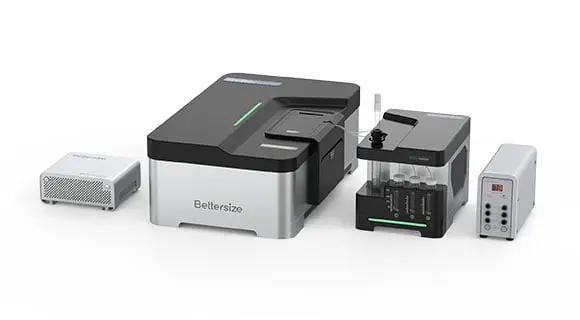
Among the available configurations, the BeNano 180 Zeta Max provides a comprehensive set of measurement technologies for demanding nanoparticle size analysis. Its capabilities include:
- 173° backscattering DLS and 90° DLS for particle size measurement
- PALS for sensitive zeta potential analysis
- SLS for molecular weight determination
- DLS microrheology for microscopic rheological characterization
- RI, concentration, and transmittance measurements
- Vertical-vertical (VV) and vertical-horizontal (VH) polarization options for additional scattering analysis
Additionally, the BeNano 180 Zeta Max accommodates a broad range of particle sizes, from 0.3 nm to 15 μm, meaning it is suitable for diverse sample types. Measurements can also be performed with sample volumes as low as 3 μL.
Alongside this, the BeNano 180 Zeta Max uses a high-sensitivity avalanche photodiode (APD) to detect weak scattering signals from small nanoparticles and biological macromolecules. Automatic laser intensity control adjusts the measurement conditions according to samples with different optical and scattering properties.
Addressing Common Challenges in Nanoparticle Size Analysis
Concentrated dispersions can be difficult to analyze with DLS since multiple scattering may interfere with the relationship between particle motion and the detected scattering signal. Paint formulations, pigment dispersions, printing inks, and electrode slurries for lithium-ion batteries may also change after dilution. Adjustable scattering volume and 173° backscattering optics allow the BeNano 180 Zeta Max to examine higher-concentration materials with less reliance on sample dilution.
Biopharmaceutical laboratories face a different constraint: limited sample availability. Protein therapeutics, antibodies, and early-stage formulations can be costly or available only in microliter quantities. Compatibility with volumes down to 3 μL conserves valuable material. Moreover, temperature-controlled trend measurements can track particle-size changes during protein aggregation, denaturation, and formulation stability studies.
Analyzing complex polydisperse systems can be extremely challenging. Overlapping particle populations can limit the resolution available from conventional batch DLS. DLS Flow Mode allows the BeNano 180 Zeta Max to operate with separation techniques such as size-exclusion chromatography/gel permeation chromatography (SEC/GPC) or field-flow fractionation (FFF).
Separated fractions pass sequentially through the analyzer, allowing higher-resolution size distributions to be obtained for mixtures containing multiple populations. This approach extends nanoparticle size analysis beyond conventional batch measurements when higher resolution for polydisperse samples is needed.
Data Integrity and Regulatory Considerations
Regulated pharmaceutical and quality control laboratories must consider more than measurement performance. Analytical workflows need reliable data handling, consistent evaluation, and traceable records that support established laboratory procedures. Software algorithms and intelligent result evaluation help standardize how nanoparticle size analysis data are processed and assessed. Support for 21 CFR Part 11 and relevant ISO requirements can aid laboratories with incorporating the BeNano 180 Zeta Max into regulated environments where data integrity, traceability, and controlled analytical processes are crucial.
Explore the BeNano Series for Nanoparticle Size Analysis
The best nanoparticle analyzer is one that can accommodate the characteristics of your samples while providing the measurements your application requires. With multiple configurations and complementary characterization capabilities, the BeNano series supports a broad range of nanoparticle size analysis workflows. Contact Bettersize Instruments now to determine which configuration most closely suits your samples.
Rate this article
Share On


Recent News