
Precautions for Particle Size Analysis of Different Pesticide Formulations
2025-10-21Bettersizer
Precautions for Particle Size Analysis of Different Pesticide Formulations
Pesticide formulations are derived from active ingredients through processing and formulation design. Owing to differences in physical form, physicochemical properties, and dispersibility, the requirements for particle size testing vary across formulations. Accurate characterization, therefore, relies on selecting appropriate test conditions for each type.
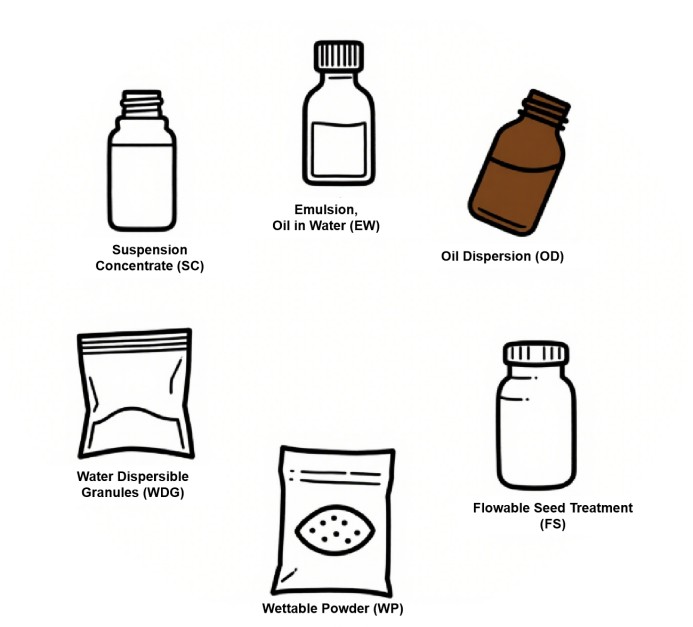
To facilitate practical application, the key precautions for each major formulation type are summarized in the following table.
Key Lab Tips for Particle Size Analysis of Pesticide Formulations
| Formulation | CommonIssues | KeyPractices |
| SC (Suspension Concentrate) | Aggregation after long storage |
Use water as dispersion medium; apply ~1 min ultrasonication if sample is aged. |
| EW (Emulsion, Oil in Water) | Unstable particle size distribution due to bubbles or demulsification |
Keep circulation speed below 800 rpm to prevent bubble formation. apply ~1 min ultrasonication to remove bubbles while preventing demulsification; use a small volume cell (e.g., BT-804) if needed. |
| OD (Oil Dispersion) | Using wrong solvent can dissolve actives; bubbles from pump/sonication |
Use formulation’s diluent as dispersion medium; pre-disperse with external ultrasonication for ~1 min; keep pump speed < 800 rpm; avoid internal sonication. |
| WP (Wettable Powder) | Bubble formation due to wetting agents in the formulation |
Directly add powder or pre-dilute; disperse < 2 min; use defoamer or short ultrasonication if bubbles occur. |
| WDG (Water Dispersible Granules) | Particle/bubble separation; excessive sonication may cause breakage |
Pre-disperse granules to form suspension; add by pipette; Keep circulation speed below 800 rpm to prevent bubble formation; apply ultrasonication < 2 min. |
| FS (Flowable Seed Treatment) | Samples may have high or low solubility; Pigments (blue/black) cause high obscuration (30–40%). |
For highly soluble samples, add sample until near saturation; apply ~1 min ultrasonication to disperse solids; High obscuration at low scattering intensity (~5) is normal for pigmented samples (blue/black), as pigments enhance laser absorption. |
General Guidelines
- SC (Suspension Concentrate), WP (Wettable Powder), WDG (Water Dispersible Granules), and FS (Flowable Seed Treatment)
Analysis target: Solid particles within the formulation.
Dispersion medium: Water.
Ultrasonication(~1 min):
· Disperse aggregated solid particles.
· Eliminate bubbles formed when the formulation enters water. - EW (Emulsion, Oil in Water)
Analysis target: Emulsion droplets.
Dispersion medium: Water.
Ultrasonication: ~1 min to remove bubbles while preventing demulsification; do not exceed 3 min, as prolonged ultrasonication may cause demulsification, leading to droplet aggregation and re-emulsification, which increases particle size.
Additional tips: Use low-speed circulation or a small-volume sample cell (e.g., BT-804) to further minimize bubble formation. - OD (Oil Dispersion)
Analysis target: Solid components of the formulation.
Dispersion medium: Use the same diluent as in production.
Ultrasonication: Avoid using internal sonication when operating an oil-resistant pump; instead, pre-disperse the sample with external ultrasonication for ~1 min.
Additional tips: Keep circulation speed low to prevent bubbles.
Rate this article
Share On


