Abstract: Dendrimers are highly branched macromolecules whose molecular weight increases systematically with generation, yet their compact architecture often leads to underestimation by conventional SEC calibration. In this study, size-exclusion chromatography coupled with static light scattering and refractive index detection was applied to determine the absolute molecular weight of dendrimers, enabling accurate characterization of different dendrimer generations.
Keywords: Dendrimer, Dendrimer generation, Absolute molecular weight, Size-exclusion chromatography (SEC)
| Product |
BeSEC |
| Industry |
Nanomaterials, Pharmaceuticals
|
| Sample |
Polyethylene terephthalate (PET) |
| Measurement Type |
Absolute molecular weight and molecular weight distribution |
| Measurement Technology |
Size-Exclusion Chromatography (SEC), Static Light Scattering
|
Introduction
Dendrimers are highly branched macromolecules with a tree-like architecture that grows outward from a central core. Lower generation dendrimers have simpler structures suitable for routine applications, while higher generations feature more terminal groups and enhanced reactivity, making them valuable for advanced functions such as drug delivery, molecular recognition, and nanotechnology.
Due to their compact structure, dendrimers exhibit high molecular density and small hydrodynamic volume, often eluting later in Size Exclusion Chromatography (SEC). Conventional calibration based on elution time tends to underestimate their molecular weight. By integrating light scattering detection within the BeSEC, absolute molecular weight can be determined from scattering intensity rather than retention time, providing accurate characterization of dendritic materials.
Experimental Section
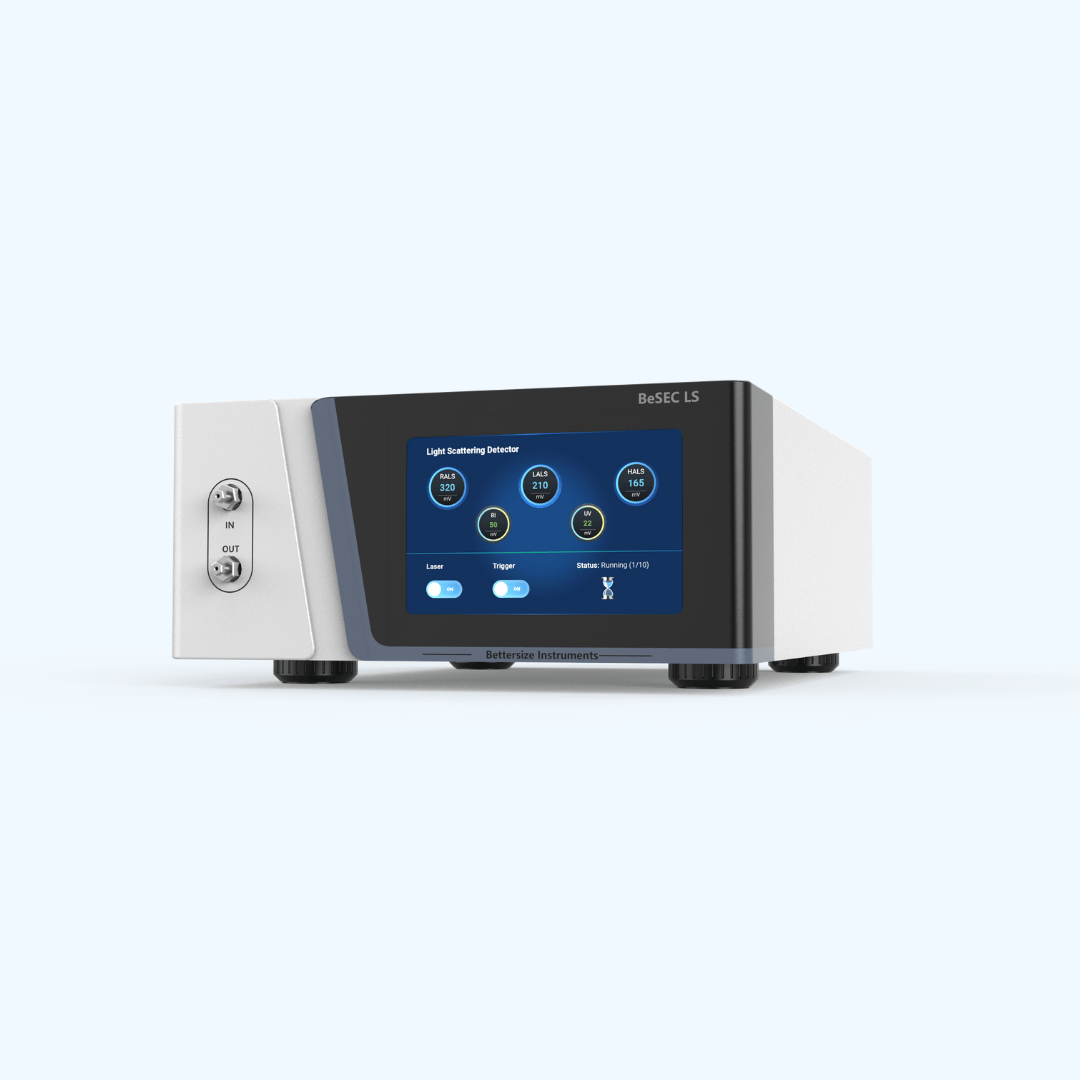
This study employed a SEC system with refractive index (RI) and light scattering (LS) detectors. The light scattering detector in the BeSEC LS2 from Bettersize Instruments includes 90° and 7° angles. The BeSEC workstation combines light scattering with RI or UV signals to calculate molecular weight averages (Mn, Mw and Mz) and distributions.
System Configuration:
-
Detectors: Light Scattering (LS) + Refractive Index (RI)
-
Column: Shodex GPC KF-806M
-
Mobile phase: 0.02 M LiBr in DMF
-
Flow rate: 0.7 mL/min
-
Injection volume: 100 μL
-
Column temperature: 40 ℃
-
dn/dc: Calculated from sample concentration
Sample Preparation:
Two dendrimer samples, G5 and G7.5, corresponding to Generation 5 and Generation 7.5, were analyzed. Each sample was accurately weighed and dispersed in DMF (10–20 mg/mL), stirred until clear, filtered through a 0.22 μm PTFE syringe filter, and transferred into vials for autosampler injection.
Results and Discussion
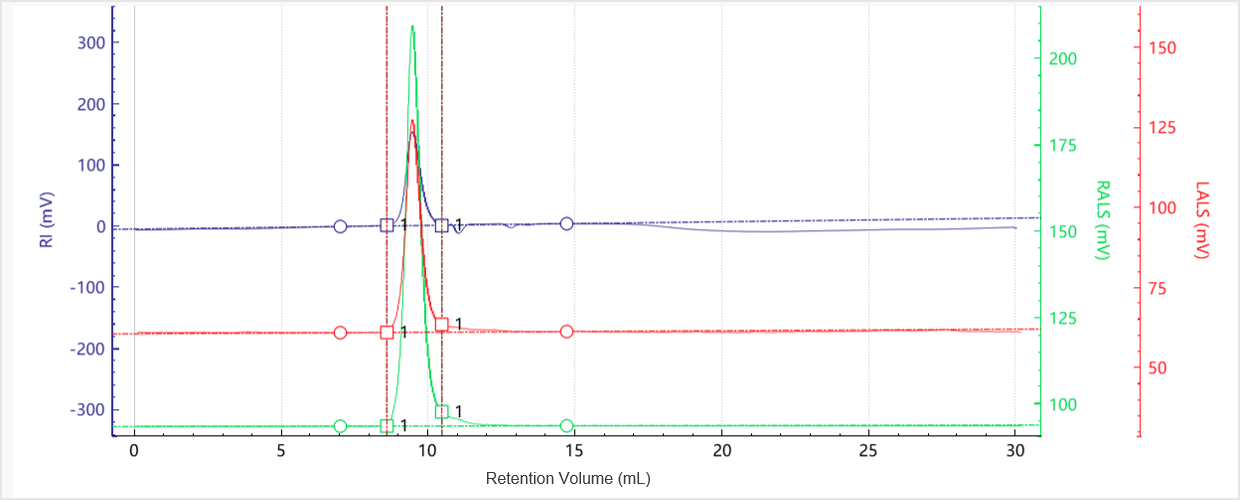
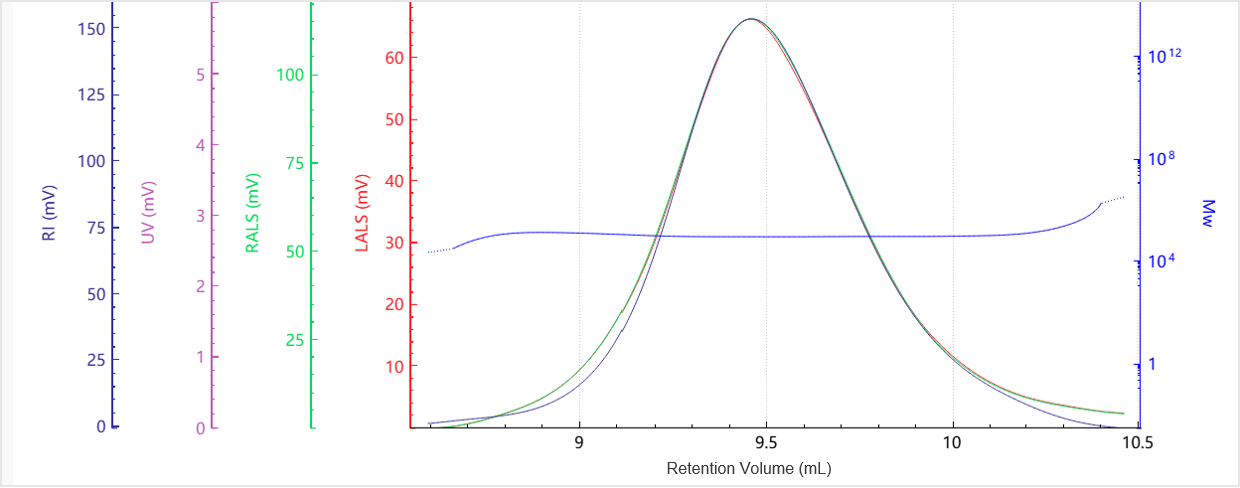
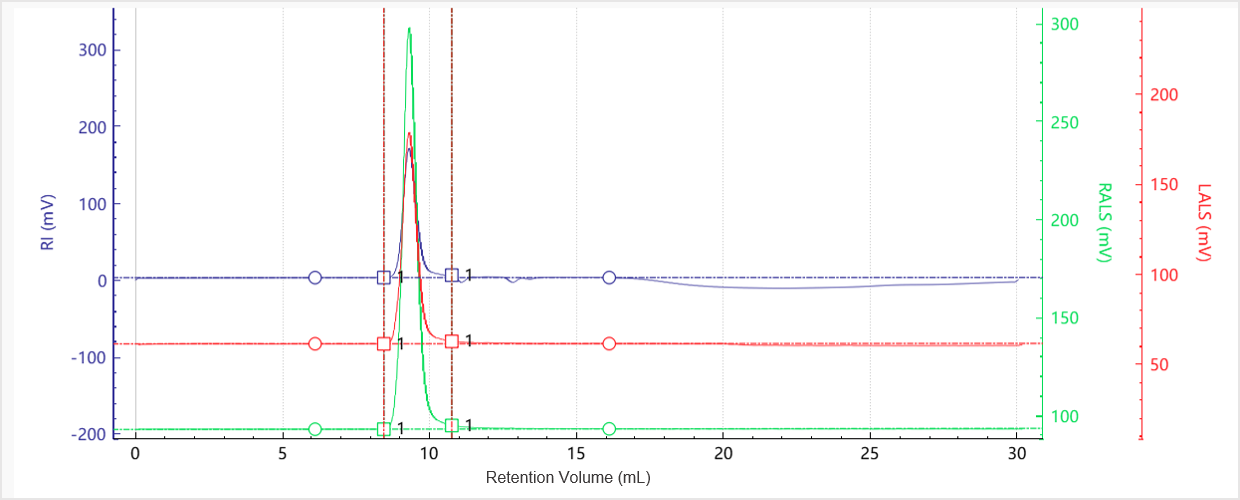
Figure 1. Elution profiles of the multi-detector signals for Sample G5
Figure 2. Elution profile of the molecular weight for Sample G5
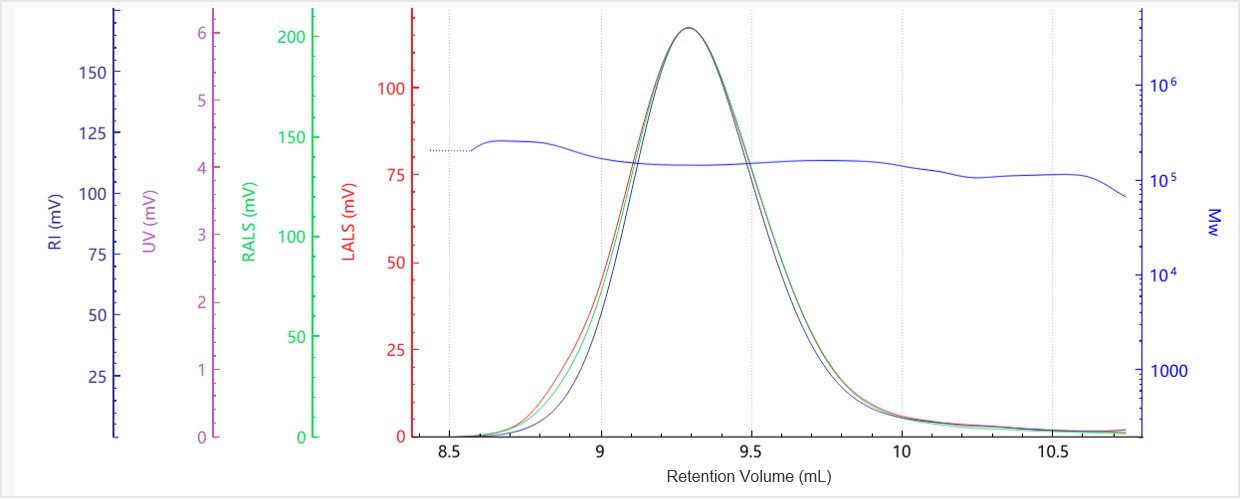
Figure 3. Elution profiles of the multi-detector signals for Sample G7.5
Figure 4. Elution profile of the molecular weight for Sample G7.5
Figures 1 to 4 display multi-detector chromatograms: RI signals in blue, right-angle light scattering (RALS) signals in green and low-angle light scattering (LALS) signals in red. The baselines are flat with minimal noise and excellent signal quality. Molecular weight profiles vary only slightly with elution volume, indicating narrow molecular weight distributions.
Both dendrimer samples elute early, near the solvent peak at approximately 11 minutes, reflecting their extremely small hydrodynamic volume. If conventional calibration based solely on RI were used, species in this region would be assigned molecular weights of only a few thousand Daltons, far below their true values.
Table 1. Molecular weight results of dendrimer samples
| No. |
Mn (Da) |
Mw (Da) |
Mz (Da) |
Mw/Mn |
| Sample G5 |
102,233 |
103,542 |
106,627 |
1.0128 |
| Sample G7.5 |
156,451 |
158,750 |
162,323 |
1.0149 |
Table 1 shows that the weight-average molecular weight increases with dendrimer generation, with both samples exceeding 100 kDa. Light scattering detection captures this trend accurately, providing reliable absolute molecular weight measurements.
Conclusion
This study utilizes the BeSEC LS2 and confirms that dendrimer molecular weights rise consistently with generation. Their narrow distributions and early elution illustrate the compact nature of dendritic structures. Unlike conventional calibration, light scattering delivers accurate molecular weight characterization, avoiding severe underestimation and enabling precise analysis of dendritic materials.
About the Authors
 |
Zhibin Guo
Application Research Lab, Bettersize Instruments Ltd.
|
BeSEC
Advanced Light Scattering Detector
- Proteins: Determine molecular weight, oligomer state, and aggregates
- Polymers & Polysaccharides: Analyze molecular weight distribution and size
- No column calibration required since Mw is independent of elution volume
- Low-angle detection enables accurate molecular weight
- Compatible with any GPC or SEC system
Learn more
|
 |
|