
Online Particle Size Monitoring of Battery Material Using the BT-Online Series Particle Size Analyzers
2026-09-24Application Note
Real-time particle size monitoring for enhanced battery material performance
The rapid growth of the new energy industry has driven increasing demand for high-performance batteries. The particle size distribution of electrode materials plays a critical role in determining battery performance, including charge/discharge rate, energy density, capacity, and cycle life. Particle size directly influences particle packing behavior and therefore affects electrode compaction density. Common cathode and anode materials, such as lithium iron phosphate (LFP), ternary materials such as nickel cobalt manganese oxides (NCM), and graphite, undergo grinding processes prior to coating, and calendering. An optimized particle size distribution (PSD) promotes uniform dispersion, improves electrode structure, and ultimately enhances battery performance.
Real-time particle size monitoring with the BT-Online Series Particle Size Analyzers provides an effective solution for continuously tracking the particle size of electrode materials in both dry and wet process lines, enabling early detection of particle size variations. In addition, the BT-Online Series can be integrated with milling equipment, including jet mills, bead mills, and ball mills, to establish a closed-loop process control system. When particle size measurements deviate from predefined specifications, corrective adjustments can be made in real time to optimize milling parameters and maintain the target particle size distribution, thereby improving manufacturing efficiency and product consistency.
Measurement of cathode materials
Commonly used cathode active materials include NCM and LFP. The production of NCM cathode materials begins with the synthesis of an NCM precursor. In this process: nickel, cobalt, and manganese salts react in the presence of precipitating and complexing agents within a reactor. The particle size of the precursor is critically importance because it influences the subsequent lithiation and sintering processes, ultimately affecting battery performance. Excessively fine particles may result in incomplete reactions with lithium salts, while overly coarse particles can increase the risk of agglomeration. Consequently, online particle size monitoring of NCM precursor synthesis provides valuable process control information.
BT-Online2 is designed for wet process, which is well suited for monitoring NCM precursor synthesis because the reaction occurs in a liquid phase. In many production environments, installing a sampling port directly on the reactor is undesirable, as it may compromise internal protective linings, such as corrosion-resistant or high-temperature-resistant coatings. To address this challenge, an external recirculation loop driven by a peristaltic pump can be installed without modifying the reactor vessel. As illustrated in Figure 1, a customized U-shaped piping assembly is connected to the reactor top flanges. The piping extends into the reactor to continuously withdraw and return material, forming a closed-loop that enables representative sampling while preserving reactor integrity.
BT-Online2 employs a pneumatic reciprocating sampler in which a pneumatic cylinder controls the opening and closing of the sample inlet path. During sampling, the piston moves downward to allow material to enter the measurement unit. After analysis, the piston moves upward to isolate the inlet path while residual material is discharged through a drainage port. This design enables efficient sampling while minimizing sample carryover and cross-contamination, ensuring reliable measurement performance. In addition, conveying gas can be introduced to facilitate the transport of viscous materials or support long-distance sample transfer.
The BT-Online2 incorporates a patented Fourier and inverse Fourier optical system, which provides measurement accuracy and repeatability comparable to laboratory-based particle size analyzers. Combined with a 92-detector array and a wide-angle detection design, the system delivers high-accuracy particle size measurements across a broad measurement range for both fine and coarse particles.
The stable measurement results shown in Figure 1 indicate that the reaction process is operating consistently and that the dispersion system of BT-Online2 effectively disperses the sampled material, ensuring representative sampling and reliable particle size measurements.
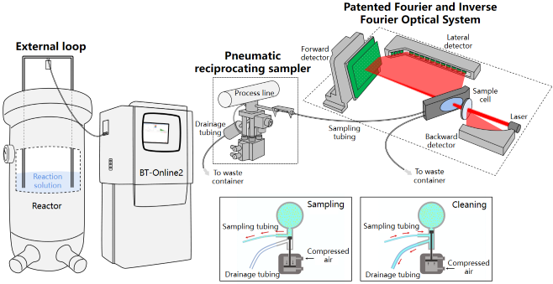
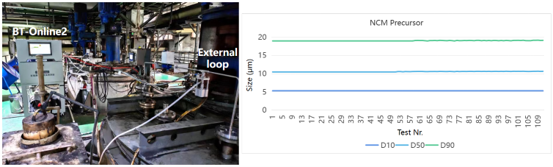
Figure 1: Online particle size monitoring of NCM precursors.
After synthesis, the NCM precursor is mixed with a lithium source and undergoes sintering, followed by pulverization and classification to achieve the target particle size distribution. Consequently, BT-Online1 can be used for real-time particle size monitoring during NCM powder processing. Likewise, BT-Online1 is well suited for monitoring LFP, another widely used cathode active material in lithium-ion battery manufacturing.
The following figure demonstrates an online particle size measurement case of LFP using BT-Online1. In this application, a 1-to-2 configuration is implemented, with two samplers installed at the outlet of a jet mill to monitor the particle size of LFP after grinding. Samples are extracted through a Venturi injector and transported to the measurement unit for analysis. Online particle size measurement of dry powders often presents challenges associated with lens contamination caused by process dust and airborne impurities. To overcome this issue, BT-Online1 incorporates dual air curtain and sheath gas technology. The air curtains create a positive-pressure barrier that prevents particles and contaminants from reaching the optical windows, while the sheath gas confines the sample stream to the measurement zone, ensuring stable and accurate measurements.
The BT-Online1 features an IP65-rated enclosure providing excellent protection against dust ingress and ensuring reliable operation in harsh industrial environments. Material compatibility is especially important in battery manufacturing, where contamination from copper or zinc may adversely affect active material performance. To minimize this risk, BT-Online1 is available in a copper- and zinc-free configuration, ensuring compatibility with sensitive battery material applications.
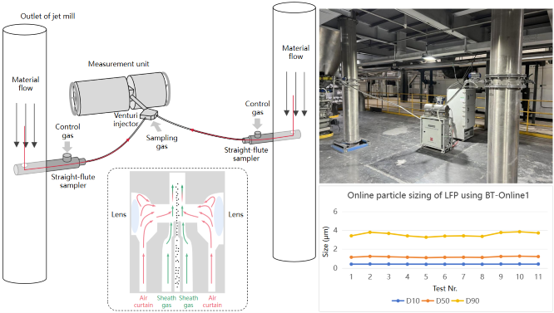
Figure 2: Online particle size monitoring of LFP using BT-Online1.
Another common approach for processing LFP materials is wet grinding using bead mills. This method reduces dust generation and can improve deagglomeration efficiency. However, the use of organic solvents as the grinding medium may introduce explosion hazards. To address these challenges, BT-Online2 is available in an explosion-proof configuration that enables safe and reliable operation in hazardous environments.
Figure 3 shows online particle size monitoring of LFP during wet grinding using ethanol as the dispersion medium. As the milling process progresses, the particle size decreases steadily, with particularly significant reductions observed in the D90 and D97 values, indicating effective particle size refinement throughout the process.
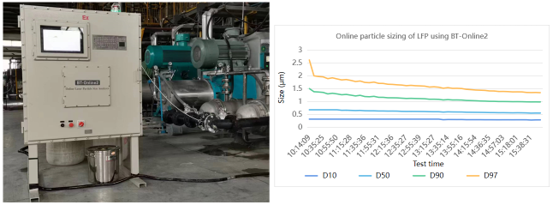
Figure 3: Online particle size monitoring of LFP using BT-Online2.
Measurement of anode materials
Graphite is the most commonly used anode material in lithium-ion batteries and is generally classified as either synthetic graphite or natural graphite. Synthetic graphite is produced through the graphitization of carbon precursors, such as petroleum coke at elevated temperatures, whereas natural graphite is obtained through mining. And beneficiation processes regardless of the source, both materials require crushing, grinding, and classification to achieve the particle size distributions required for battery applications.
Real-time particle size monitoring during graphite processing is essential for ensuring product consistency and maximizing manufacturing efficiency. BT-Online1 can transmit measurement data directly to plant control systems through communication methods, such as Modbus TCP/IP, Modbus RTU, OPC, and 4-20 mA analog outputs. When particle size measurements deviate from target specifications, the control system can use this information to adjust process parameters in real time, helping ensure that graphite material meets downstream processing requirements.
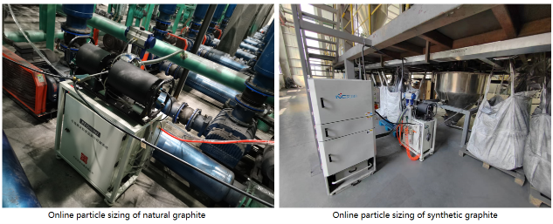
Figure 4: Online particle size monitoring of graphite.
Conclusion
The BT-Online Series Particle Size Analyzers are widely used in the battery industry for real-time monitoring of cathode and anode material particle size during manufacturing. The system offers a range of installation and configuration options to address diverse process requirements, including dry and wet applications, explosion-proof environments, and copper- and zinc-free material contact configurations. By providing accurate and reliable particle size measurement and seamless integration with plant control systems, the BT-Online Series supports real-time process feedback, helping manufacturers maintain consistent product quality and optimize production performance.
 |
Paddy Zhou Application Engineer Application Research Lab, Bettersize Instruments Ltd. |
 |
BT-Online Series
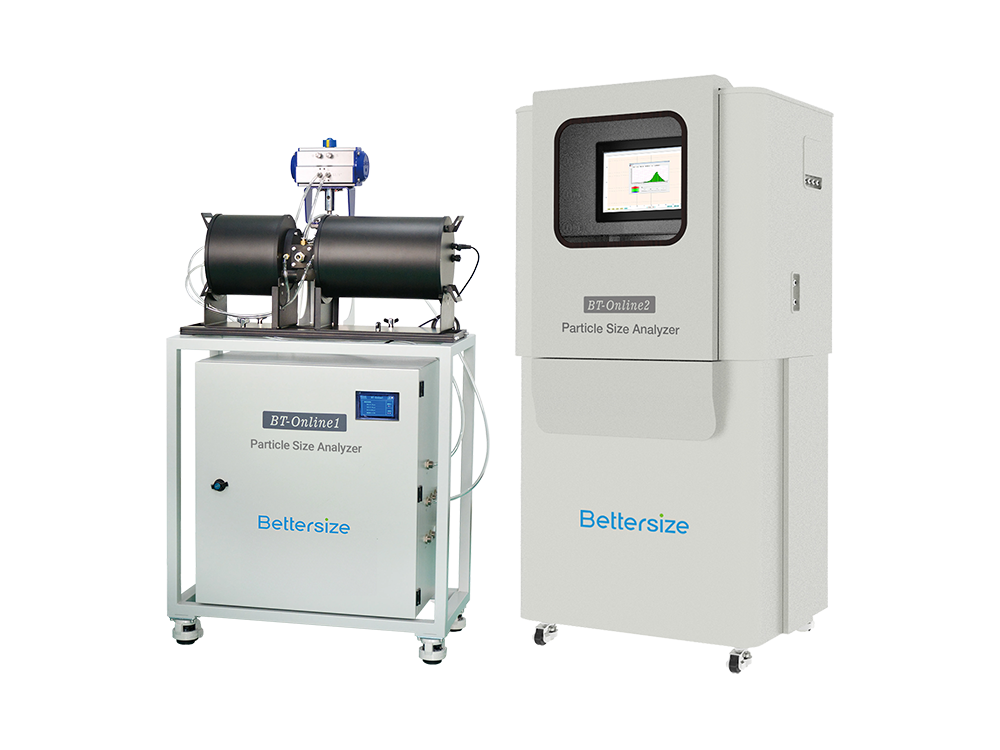
Online Particle Size Analyzers Real-time particle size monitoring for dry and wet battery-material process lines.
BT-Online1 supports dry powder processing and plant control integration.
BT-Online2 supports wet processes and explosion-proof configurations.
|
LOGIN TO ACCESS EXCLUSIVE CONTENT
More Resources Including
- Application Notes & Collections
- Webinars & Workshops
- Presentations & Videos
- Monthly Newsletters
- Exclusive Events...

Recommended articles
Rate this article