
What are the differences between light extinction and laser diffraction technique?
2023-07-18WIKI
In an optical particle counter, particles are closely arranged one by one in a straight line in one dimension in the sample flow. In an ideal situation, particles will enter the illuminated area individually, and one pulse signal corresponds to one particle whose signal height will be applied for particle size calculation. In a laser diffraction particle size analyzer, particles are circulated in the dispersion system and irradiated by the laser beam, leading to a signal diagram that is generated through the overlapping of numerous single signals. In the optical particle counter, only the scattered signal at a certain angle will be received. In contrast, photodetectors are arranged in large quantities in specific locations in the laser diffraction particle size analyzer.
For a single particle, most of the scattered signals generated can be received, theoretically, resulting in a signal diagram of a single particle. When numerous particles are illuminated by a laser beam simultaneously, the signal diagram displayed is integrated by innumerable signals of the single particles. Under these circumstances, the particle size calculation cannot be achieved using a calibration curve. Instead, the inverse algorithm is a solution, in which the particle size distribution can be acquired by comparing the theoretical light intensity distribution based on assumption with the measured light intensity distribution. When the residual is within the acceptable range, the assumption can be considered the measurement result.
 |
Struggling to grasp particle analysis concepts? Our new Beginner's Guide to Particle Analysis is here to help you grasp these concepts in the most accessible manner possible. Download it as a PDF to read on the train, on the plane, or wherever else there’s no internet. |

Recommended articles
Rate this article
Share On


Related Particle Size Analyzer
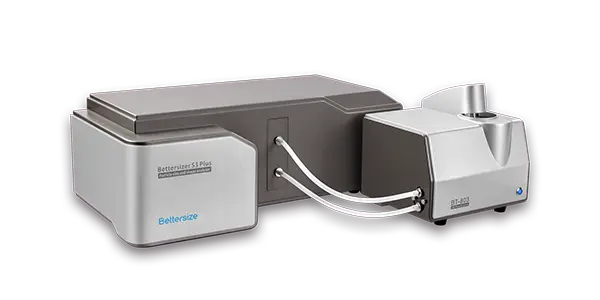
Bettersizer S3 Plus
Laser Diffraction Particle Size Analyzer
Measurement range: 0.01 - 3,500μm (Laser System)
Measurement range: 2 - 3,500μm (Image System)
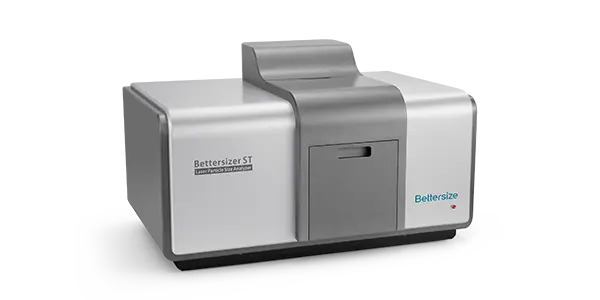
Bettersizer ST
One-stop Particle Size Analyzer
Dispersion type: Wet
Measurement range: 0.1 - 1,000µm
Repeatability: ≤1% variation

Bettersizer 2600
Particle Size Analyzer
Measurement range: 0.02 - 2,600μm (Wet dispersion)
Measurement range: 0.1 - 2,600μm (Dry dispersion)