
How does stability analysis complement zeta potential measurement and laser diffraction particle size analysis?
2024-09-24WIKI
Zeta potential and laser diffraction particle size analysis can be applied to indicate the stability of a dispersion. Dispersion with a large absolute value of zeta potential or small particle size is considered stable from general experiences. However, it is risky to evaluate stability with only one parameter. Stability analysis based on SMLS is a comprehensive solution, which considers all factors that can affect stability. The combination of stability analysis and zeta potential measurement or laser diffraction particle size analysis reveals the relationship between the stability of dispersion and its zeta potential or particle size, which facilitates formulation development and quality control.
 |
Struggling to grasp particle analysis concepts? Our new Beginner's Guide to Particle Analysis is here to help you grasp these concepts in the most accessible manner possible. Download it as a PDF to read on the train, on the plane, or wherever else there’s no internet. |

Recommended articles
Rate this article
Share On


Related Particle Size Analyzer
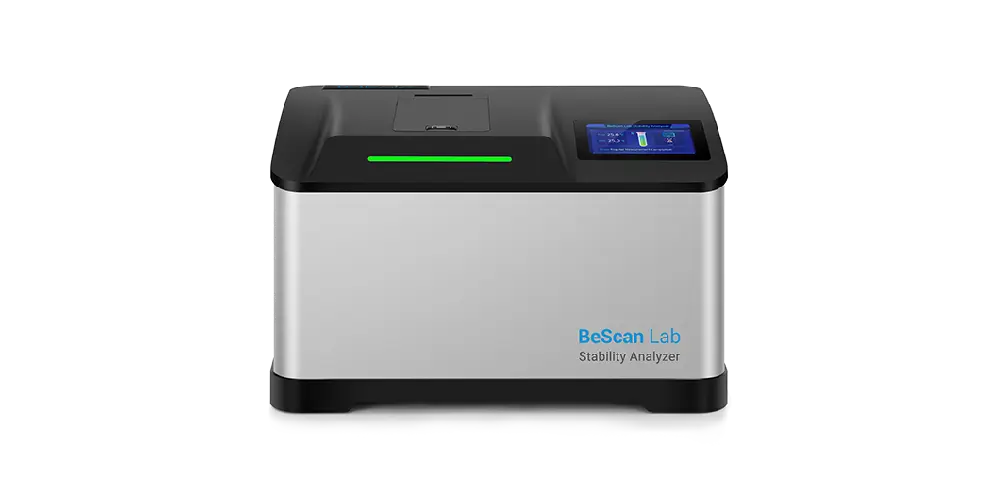
BeScan Lab
Stability Analyzer
Particle size ranges from 10 nm to 1 mm
Volume fraction up to 95%
Compliance with ISO/TR 18811, 13097, 21357, 22107