
Particle Size measurement of High-concentration Pigment Samples with DLS Technology
2021-03-02Application Note
The particle sizes of high concentration pigments had been characterized successfully by the DLS technology of the BeNano 90 Zeta. Using the capillary sizing cell compatible with the BeNano 90 Zeta, even samples with high concentrations and low transmittance can be analyzed to yield reliable and accurate results.
| Product | BeNano Series |
| Industry | Paints, Inks, Pigments and Coatings |
| Sample | High-concentration Pigment |
| Measurement Type | Particle Size |
| Measurement Technology |
Jump to a section:
Introduction
Pigments are either organic or inorganic coloring materials. In the manufacturing process, pigments need to meet many technical criteria, including ease of application, color strength, durability or light and weather fastness, all of which are closely related to the size of the pigment particles.
In this application note, dynamic light scattering (DLS) technology was utilized to measure the particle sizes of two high-concentration pigment suspensions. Due to the high concentration and poor light transmittance of the sample, a capillary sizing cell with an inner diameter of 1 mm was used for the DLS measurement.

Theory and Instrumentation
Dynamic Light Scattering measures the intensity fluctuations of the sample due to Brownian motions of particles. The diffusion coefficient D is obtained and related to the particle size, i.e., the hydrodynamic diameter DH, by the Stokes-Einstein equation.

Where kB is the Boltzmann constant, T is the temperature, and η is the dispersant viscosity.
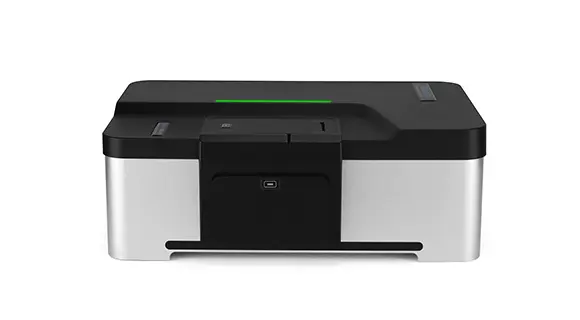
In this study, the pigment samples were characterized by the BeNano 90 Zeta of Bettersize Instruments Ltd., which adopts a 10mW laser with the wavelength of 633nm. In addition, in the BeNano 90 Zeta, single-mode optical fibers are used for signal transmission to maximize the signal to noise ratio; high-speed correlators are utilized such that the fast-decay correlation functions of small particles can be calculated effectively.
Experiment
A red and a yellow pigment were pre-dispersed in purified water for the particle size measurements. The measurement temperature was set to be 25℃ ± 0.1℃ through the built-in temperature control system of the BeNano 90 Zeta. Each sample was measured at least three times to ensure a low standard deviation of the results.

Results and Discussion
Correlation functions of two pigment samples were calculated through their scattered light signals and the overlap correlation functions of multiple measurements are shown in Figure 1 and Figure 2.
As shown, the repeatability of the correlation function is good, indicating the samples remain stable during the measurement. Neither the color nor the high concentration of samples affected the measurement results.


|
Sample
|
Z-ave (nm)
|
PdI
|
|
Red Pigment
|
112.49 ± 1.42
|
0.528
|
|
Yellow Pigment
|
267.54 ± 2.69
|
0.391
|
Figure 3 and 4 suggest that both particle size distributions of red and yellow pigments were wide with two peaks detected. The peak of small particles was at around 40nm, whereas the peak of large particles was at hundreds of nanometers.
As can be seen in Table 1, though both pigment samples were nanometer-sized, the yellow pigment sample had a larger particle size but a narrower particle size distribution than the red pigment sample.
Conclusions
The particle sizes of high concentration pigments (red and yellow samples) had been characterized successfully by the DLS technology of the BeNano 90 Zeta. Using the capillary sizing cell compatible with the BeNano 90 Zeta, even samples with high concentrations and low transmittance can be analyzed to yield reliable and accurate results.
About the Authors
| Shelly Zhang, Zhibin Guo, Hui Ning Application Engineers @ Bettersize Instruments |
|
Advanced Nanoparticle Size & Zeta Potential Analysis
|
|
LOGIN TO ACCESS EXCLUSIVE CONTENT
More Resources Including
- Application Notes & Collections
- Webinars & Workshops
- Presentations & Videos
- Monthly Newsletters
- Exclusive Events...

Recommended articles
Rate this article