
Online Particle Size Monitoring of Cement Using BT-Online1
2026-09-22Application Note
Replacing Traditional Sieving Methods with Laser Diffraction Analysis
Cement has played a fundamental role in the construction industry for thousands of years and remains one of the most important components of concrete and mortar. The performance of cement is influenced by various factors, including its chemical composition, water-to-cement ratio, and particle size. Among these, cement fineness is particularly important because it directly affects hydration behavior, setting time, strength development, and permeability.
Traditionally, cement fineness has been characterized by using standardized test methods. The Blaine air permeability method, specified in ASTM C204 and EN 196-6, determines the specific surface area of cement as an indirect measure of fineness. EN 196-6 also specifies sieve analysis and air-jet sieving methods for quantifying the proportion of particles above a specified size. While these methods are well established and widely used in the cement industry, they provide only limited information about the actual particle size distribution (PSD) of the material.
To obtain a complete understanding of cement particle size characteristics, laser diffraction has become an increasingly valuable analytical technique. Unlike traditional fineness measurements, laser diffraction provides detailed PSD information across a wide particle size range, allowing manufacturers to better understand and control product quality.
BT-Online1: A Reliable Solution for Real-Time Cement Process Monitoring
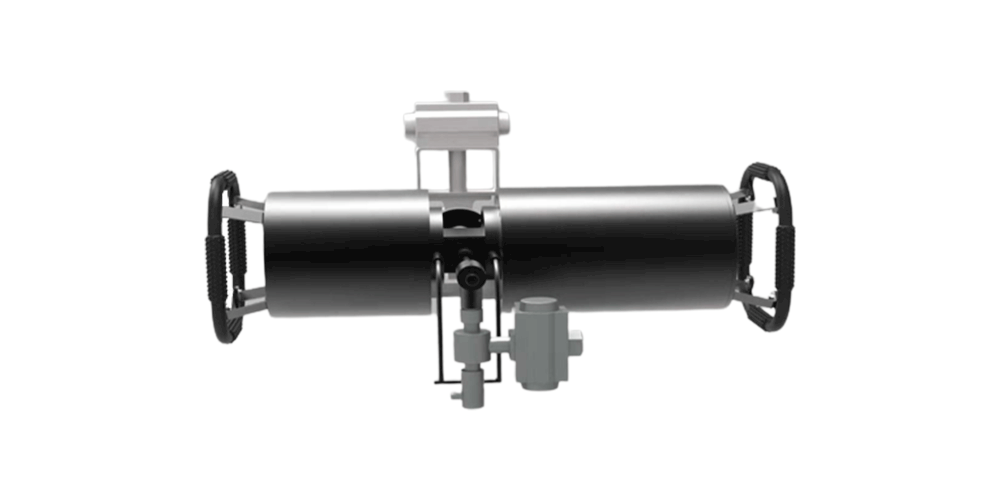
The BT-Online1 is specifically designed for continuous online particle size measurement of dry powder process streams, including cement process lines. Utilizing laser diffraction technology, the system delivers accurate and reliable particle size data around the clock, enabling true 24/7 process monitoring.
During operation, cement powder is automatically extracted from the process stream using a Venturi-based sampling system and transported directly to the analyzer for measurement. A variety of samplers are available to accommodate different installation locations, including air slides, gravity chutes, mill outlets, and other process transfer points.
The selection of the optimal sampler depends on process conditions such as material flow characteristics, installation constraints and environmental factors. When standard sampling solutions are not suitable, customized sampling solutions can be developed to meet specific site requirements.
Dust accumulation on optical components is a common challenge encountered in cement plants due to the harsh operating environment. The BT-Online1 addresses this issue through a robust optical protection system combining dual air curtains and sheath gas technology to prevent lens contamination. In addition, the analyzer features an IP65-rated enclosure, providing excellent protection against dust ingress and ensuring reliable long-term operation performance.
A single BT-Online1 unit can support up to four independent process lines, significantly reducing equipment investment while maximizing process visibility. The measurement data can be transmitted directly to plant control and management systems, enabling operators to make timely process adjustments based on real-time results. This supports consistent product quality, optimized production efficiency, and reduced operating costs.
Working Principle
Following Figure 1 illustrates a typical BT-Online1 installation in a cement plant: In this example, a single analyzer monitors 2 cement process lines using a 1-to-2 sampling configuration. Sampling tubes are installed on two air slides and connected to the analyzer through a Y-type fitting. Ball valves control the selection of each sampling channel.
When measurement begins, negative pressure generated by the Venturi injector draws cement powder into the sampling tube. The sample is then transported to the analyzer, dispersed and measured using laser diffraction technology. Particle size data results are automatically transmitted to the plant PLC or control system for process monitoring and feedback control.
The BT-Online1 supports multiple communication protocols, including: Modbus TCP/IP, Modbus RTU, OPC, and 4-20 mA analog signal output. If the measured particle sizes deviate from specified control limits, corrective adjustments can be made to upstream process equipment, such as the ball mill or separator, to restored the desired product particle size.
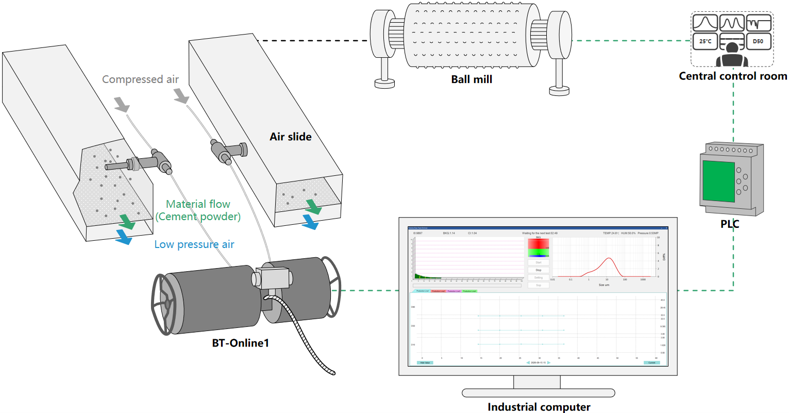
Figure 1: Real-time online particle size monitoring for cement powder production.
The monitoring software displays both numerical values and real-time trend curves. In addition to commonly used particle size parameters such as D10, D50, and D90, users can display application specific metrics, including: percentage of particles between 3 and 32 μm, R45 residue, Customized particle size fractions. This flexibility allows operators to monitor parameters most relevant to their production and quality control objectives.
Reliable Performance Under Diverse Plant Conditions
A comprehensive site survey is essential prior to installation to ensure optimal sampling performance and measurement reliability. Sampling system design should be adapted to process conditions and material flow characteristics.
For example, constant-quantity sampler is ideal for stable material flow, while sample auger is recommended for fluctuating or inconsistent material flow.
Environmental factors such as dust concentration and ambient temperature must also be considered during system design. The BT-Online1 is specifically engineered for challenging industrial environments and provides reliable operation even under severe dust conditions. For high-temperature installations, a water-cooled condenser with a recirculating cooling loop can be incorporated into the system to maintain suitable operating temperatures and ensure long-term instrument stability. The following are examples of BT-Online1 installations in cement plants.
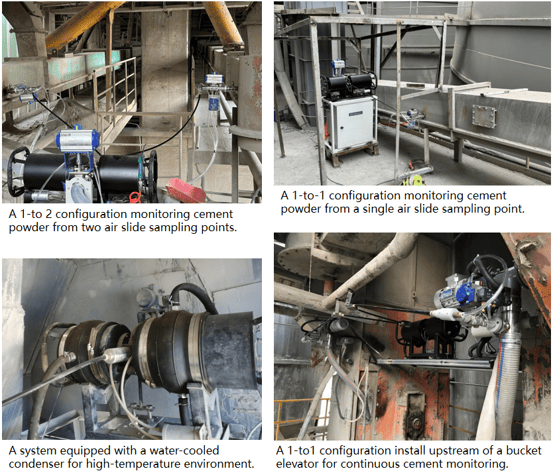
Figure 2: Examples of BT-Online1 installations in cement productions facilities.
Tromp Curve Analysis: Evaluating Classification Performance
The Tromp curve is a widely used tool in the cement and mineral industries for evaluating the performance of classification equipment such as cyclone separator and hydrocyclone. The Tromp curve is a graph that plots the particle size against the probability of a particle going into the coarse reject stream. By analyzing the Tromp curve, users can gain valuable insight into how effectively particles are separated between fine and coarse streams.
The BT-Online1 analysis software includes a built-in Tromp curve analysis function. By entering the particle size distributions and corresponding material mass flow rates of the feed, fine, and coarse streams, the software automatically generates the Tromp curve together with key classification performance indicators.
One of the most important parameters is the cut size (D50), which represents the particle size at which approximately 50% of the particles enter the coarse stream. When a target cut size is defined, an actual D50 closer to the target indicates that the separator is operating near the desired process conditions. However, cut size (D50) alone is insufficient to fully characterize separator performance. The shape of the Tromp curve must also be evaluated.
Ideally, the proportion of particles reporting to the coarse stream increases sharply with particle size, producing a steep S-shaped curve. In real-world applications, however, factors such as airflow entrainment, turbulence, and particle agglomeration can cause some fine particles to bypass the separator and enter the coarse stream. As a result, the Tromp curve may not approach zero in the fine particle region.
Another important parameter is imperfection, which quantifies the sharpness of the separation. In general, lower imperfection values indicate a steeper Tromp curve and a more efficient classification process, meaning that particles of different sizes are more effectively separated.
The software clearly displays critical separator performance metrics, including cut size (D50), imperfection, and bypass percentage. By combining real-time particle size monitoring with integrated Tromp curve analysis, the BT-Online1 provides not only continuous product quality monitoring but also deeper process insight into the classification performance of the separator.
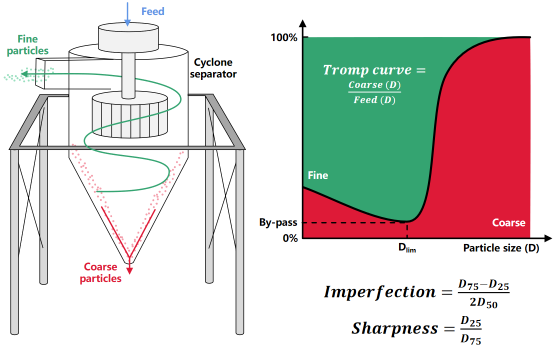
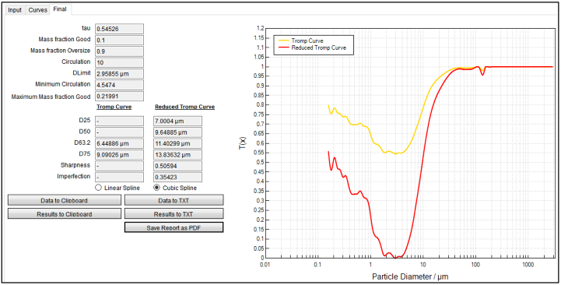
Figure 3: Tromp curve analysis and software interface.
Conclusion
The BT-Online1 provides a comprehensive solution for online particle size monitoring in cement production process. Its flexible sampling solutions, robust industrial design, and advanced laser diffraction technology enable reliable operation across a wide range of process conditions and plant environments.
Combined with intuitive software that delivers both real-time particle size analysis and Tromp curve, the BT-Online1 helps operators optimize grinding and classification processes, maintain consistent product quality, improve production efficiency, and reduce operating costs. As a result, the BT-Online1 serves as a powerful process analytical tool for modern cement manufacturing facilities.
 |
Paddy Zhou Application Engineer @ Bettersize Instruments |
 |
BT-Online1
Real-time Insights for Smart Processes Multi-line Capacity
Enable Closed-loop Control
24/7 Automated Operation
• Flexible Configurations & Customized Installation
|
LOGIN TO ACCESS EXCLUSIVE CONTENT
More Resources Including
- Application Notes & Collections
- Webinars & Workshops
- Presentations & Videos
- Monthly Newsletters
- Exclusive Events...

Recommended articles
Rate this article