
Determining the Size and Zeta Potential of Alumina Abrasive
2022-01-14Application Note
The BeNano 90 Zeta was employed successfully to determine the size and zeta potential of nano alumina dispersed in the aqueous environment. The measurement results suggest that the nano alumina is close to monodisperse in size and possesses high stability with the zeta potential amplitude over 30 mV.
| Product | BeNano Series |
| Industry | Abrasives |
| Sample | Alumina |
| Measurement Type | Particle Size, Zeta Potential |
| Measurement Technology |
Dynamic Light Scattering, Electrophoretic Light Scattering
|
Jump to a section:
Nano alumina is extensively used for high-precision polishing of materials such as optical lenses, microcrystalline glass substrates, crystal surfaces, gemstones, glass products, metal products, semiconductors, plastics, etc. The stability of polishing suspension is significant for preventing the formation of alumina aggregates that may lead to scratches on workpieces. To evaluate the stability of polishing suspension, zeta potential, a key indicator, must be accurately determined.
In this application note, the size and zeta potential of nano alumina dispersed in the aqueous environment were characterized by the BeNano 90 Zeta.
Instrumentation
The BeNano 90 Zeta nanoparticle size and zeta potential analyzer is equipped with a solid-state laser with a wavelength of 671 nm and a power of 50 mW. The scattered light signals of the sample at 90° are collected for DLS measurement. The calculation of the intensity fluctuation provides a correlation function. The diffusion coefficient could, then, be obtained. With the Stokes-Einstein equation, the size and size distribution of the sample are determined. The scattered signals at 12° are used to provide the electrophoretic mobility by applying the phase analysis light scattering (PALS) technique, with which the zeta potential of the sample could be derived from the Henry equation.
Sample Preparation
The highly concentrated stock of nano alumina slurry was diluted in deionized water by 100 times. The measurement temperature was maintained at 25 °C using the built-in temperature control unit in the BeNano 90 Zeta. The polystyrene (PS) cell was used for DLS measurement, whereas the folded capillary cell was used for zeta potential measurement. Each sample was measured at least 3 times to investigate repeatability of results and obtain standard deviations.
Results and Discussion
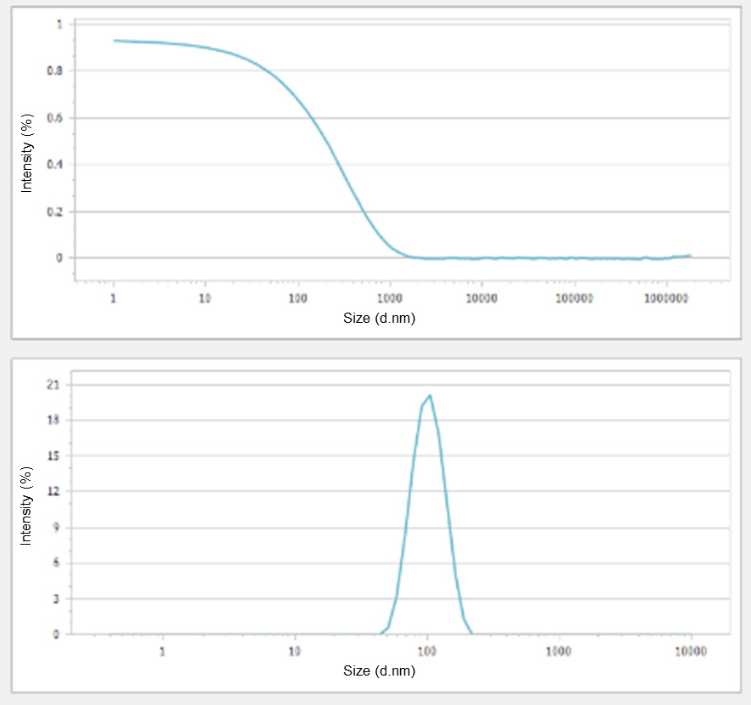
Using the DLS technique, the size and size distribution of the nano aluminum oxide were measured. The Z-average diameter is 100.91 nm, and the polydispersity index (PDI) is 0.034. The size distribution showed a single peak, with PDI being smaller than 0.05, indicating that the nano aluminum oxide is close to monodisperse in size.
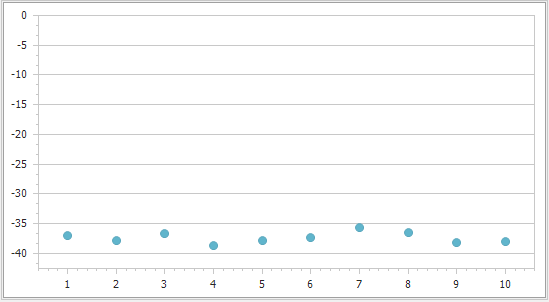
| Test | Zeta Potential (mW) |
| 1 | -37.0 |
| 2 | -37.9 |
| 3 | -36.6 |
| 4 | -38.6 |
| 5 | -37.8 |
| 6 | -37.2 |
| 7 | -35.6 |
| 8 | -36.4 |
| 9 | -38.1 |
| 10 | -37.9 |
| Mean | -37.3 |
| Standard Deviation | 0.92 |
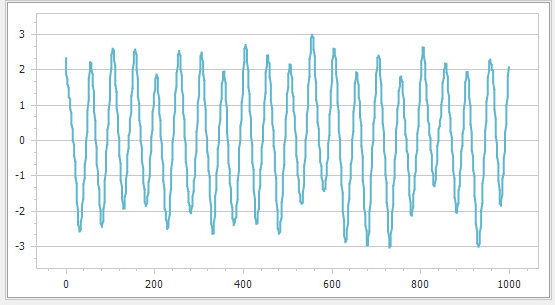
Through the PALS technique, the zeta potential of nano alumina was detected. Figure 2 shows the phase plot of the zeta potential measurement, whose slope indicates the light frequency shift due to electrophoresis. The slope is shown to be steep, demonstrating a high signal-to-noise ratio.
The values of zeta potential resulting from 10 measurements are shown in Table 1. As illustrated, the zeta potential values of nano aluminum oxide in water were negative, suggesting that the particle surfaces are carrying negative charges. The mean value of zeta potential is 37.3 mV, and the standard deviation is 0.92 mV, showing good result repeatability. The amplitude of the zeta potential is over 30 mV, suggesting high stability of the suspension. Additionally, PDI being 0.034 further proves such stability with the lack of aggregates.
Conclusion
The BeNano 90 Zeta was employed successfully to determine the size and zeta potential of nano alumina dispersed in the aqueous environment. The measurement results suggest that the nano alumina is close to monodisperse in size and possesses high stability with the zeta potential amplitude over 30 mV.
About the Authors
 |
Zhibin Guo Application Manager @ Bettersize Instruments |
 |
Dr. Ning Chief Product Officer @ Bettersize Instruments |
|
Advanced Nanoparticle Size & Zeta Potential Analysis
|
|
LOGIN TO ACCESS EXCLUSIVE CONTENT
More Resources Including
- Application Notes & Collections
- Webinars & Workshops
- Presentations & Videos
- Monthly Newsletters
- Exclusive Events...

Recommended articles
Rate this article