
See Through the Muddy Flow: How Bettersize’s New US Patent Solves Window Contamination in In-Situ Sediment Monitoring
2026-07-17News
See Through the Muddy Flow: How Bettersize’s New US Patent Solves Window Contamination in In-Situ Sediment Monitoring
Discover how the DeepSizer 300 uses a patented differential optical path method to mathematically remove window-fouling interference and maintain accurate particle size distribution and solid content measurements in complex two-phase flows.
Instead of relying on frequent manual cleaning or fixed background estimates, the DeepSizer 300 compares signals from two optical path lengths and subtracts the shared contamination component, leaving the true sediment signal.
1. Real-World Challenge of Two-Phase Flow Monitoring
In hydrological monitoring, tracking the particle size gradation and solid content of sediment in rivers, oceans, and ports is critical for soil erosion prevention, dam maintenance, and waterway regulation. These environments represent complex liquid-solid two-phase flows.
Continuous monitoring requires instruments to remain submerged in non-pure media for extended periods. As a result, the measurement window inevitably becomes contaminated, affecting both the optical background and the accuracy of the final results.
To address this limitation, the United States Patent and Trademark Office granted US Patent 12,680,936 B2 to Dandong Bettersize Instruments Ltd. on July 14, 2026. The patent introduces a differential optical path methodology designed specifically to compensate for window contamination in online monitoring systems.
2. Core Problem: The “Dirty Window” Effect
|
Absence of Pure Backgrounds
Active rivers and industrial flows are not pure-medium environments. The instrument cannot capture a clean background signal in real time and must rely on a fixed background estimate, which can interfere with the actual sediment scattering signal. |
Lens Fouling
Long-term immersion causes contamination on the measurement window. This fouling introduces errors into both extinction and scattering signals, compromising particle size gradation and solid content calculations. |
3. The Solution: Differential Optical Path Measurement
|
Long Optical Path
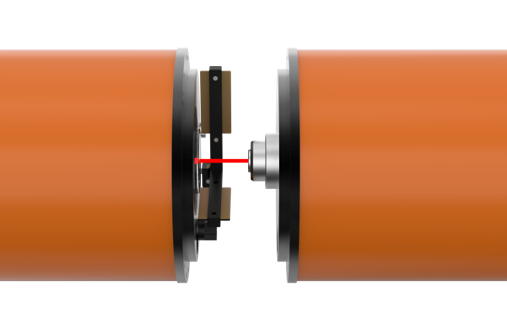 |
Short Optical Path
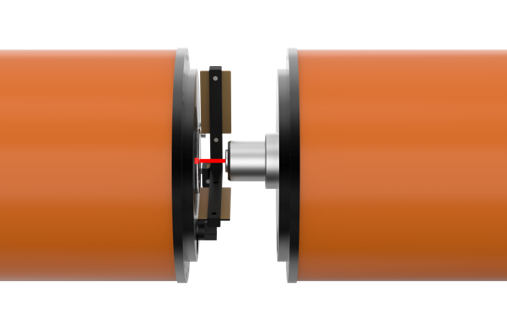 |
3.1 How Does the DeepSizer 300 Compensate for Window Contamination?
3.2 Mathematical Isolation of Solid Content
For accurate solid content calculation, the DeepSizer 300 processes the extinction values logarithmically. The difference between the logarithms isolates the actual solid particles from the contaminated window interface:
By defining the volume concentration (Cv) and using the surface area mean diameter (D) inverted from Mie scattering data, the solid content (H) can be calculated using particle density (ρ):
4. Lower Operational Expenditure and Unbiased Data Integrity
Traditional submersible sensors need frequent, labor-intensive retrieval from the waterbody for maintainence. By mathematically negating this fouling, the differential path method drastically reduces maintenance intervals, saving field labor costs and operational time.
Manual water sampling forces personnel to collect sample from where it is physically accessible—often too close to the riverbank or surface. This introduces heavy data bias that fails to reflect the true sediment dynamics of the main channel. The DeepSizer 300 remains continuously deployed in the representative flow zone, delivering accurate, unbiased in-situ data.
Over time, window fouling in liquid-solid two-phase flows creates optical noise that obscures actual particle data. The patented differential method isolates a pure scattered light intensity signal by mathematically subtracting this shared error variable. As a result, the DeepSizer 300 can continuously calculate accurate particle size distribution and solid content without needing periodic zero-baseline recalibrations in a pure medium.
5. Bettersize’s Technological Authority
The granting of US Patent 12,680,936 B2 transitions in-situ sedimentation monitoring from a hardware maintenance vulnerability into a stable, algorithmically validated process.
By mathematically eliminating the primary source of online measurement drift, Bettersize Instruments and the DeepSizer 300 establish a new baseline for data reliability in complex, two-phase flow environments.
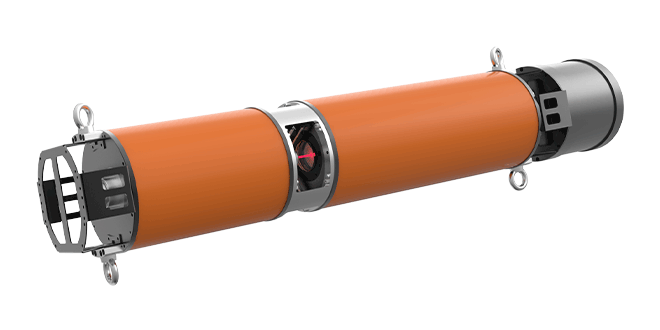
Learn how the DeepSizer 300 supports continuous particle size distribution and solid content measurement in demanding field environments.
Learn MoreLOGIN TO ACCESS EXCLUSIVE CONTENT
More Resources Including
- Application Notes & Collections
- Webinars & Workshops
- Presentations & Videos
- Monthly Newsletters
- Exclusive Events...

Recommended articles
Rate this article