ABSTRACT
Angle of repose is widely used to characterize powder flowability, yet the measurement is often obtained from a single viewing direction despite the possibility of asymmetric pile formation. In this study, PowderPro X1 was used to compare fine calcium carbonate with a Ti alloy powder used in additive manufacturing. The instrument rotates the horizontal camera through 180° to capture a complete azimuthal angle-of-repose distribution. Additional measurements, including Angle of Fall, Angle of Difference, Angle of Spatula, and Angle of Sliding Friction, were used to provide a more comprehensive assessment of powder behavior.
Calcium carbonate exhibited substantially greater directional variation than the Ti alloy powder, with a 360° angle-of-repose range of 27.09°–41.69°, compared with 25.91°–26.52° for the Ti alloy powder. The higher complementary angle values measured for calcium carbonate further indicated greater pile instability, interparticle resistance, and powder–surface interaction. These results demonstrate that multi-angle characterization provides a more complete understanding of powder flow behavior than a single angle-of-repose value alone.
KEYWORDS
360° angle of repose; multi-angle powder testing; calcium carbonate flowability; additive manufacturing powder; PowderPro X1
|
Product
|
|
|
Industry
|
|
|
Sample
|
Fine calcium carbonate powder
|
|
Measurement Type
|
|
|
Measurement Technology
|
INTRODUCTION
The angle of repose is one of the most widely used indicators of powder flowability because it is simple to measure and easy to interpret. In many testing approaches, however, the measurement is obtained from a single side view of the powder pile. This practice implicitly assumes that the pile is rotationally symmetric—an assumption that may not be valid for fine, cohesive, irregularly shaped, or segregating powders.
Powder piles frequently develop directional differences due to uneven deposition, agglomeration, particle shape effects, surface roughness, or minor disturbances during pile formation. As a result, the angle measured from one viewing direction may not accurately represent the overall geometry of the pile. Depending on the selected measurement plane, the reported value may underestimate or overestimate the true flow behavior of the material.
This limitation is particularly relevant in additive manufacturing applications, where powder feeding, spreading, and layer recoating occur across multiple directions and depend on consistent powder behavior throughout the process. Characterizing only a single cross-section may overlook important information about powder uniformity and flow consistency.
In this study, fine calcium carbonate was selected as a model powder expected to form an asymmetric pile, while a Ti alloy additive manufacturing (AM) powder represented a material with relatively uniform particle shape and flow behavior. The objective was to evaluate how 360° azimuthal angle-of-repose measurements, combined with other complementary angle-based tests, provide a more complete understanding of powder flow characteristics.
INSTRUMENT AND MATERIALS
Instrument
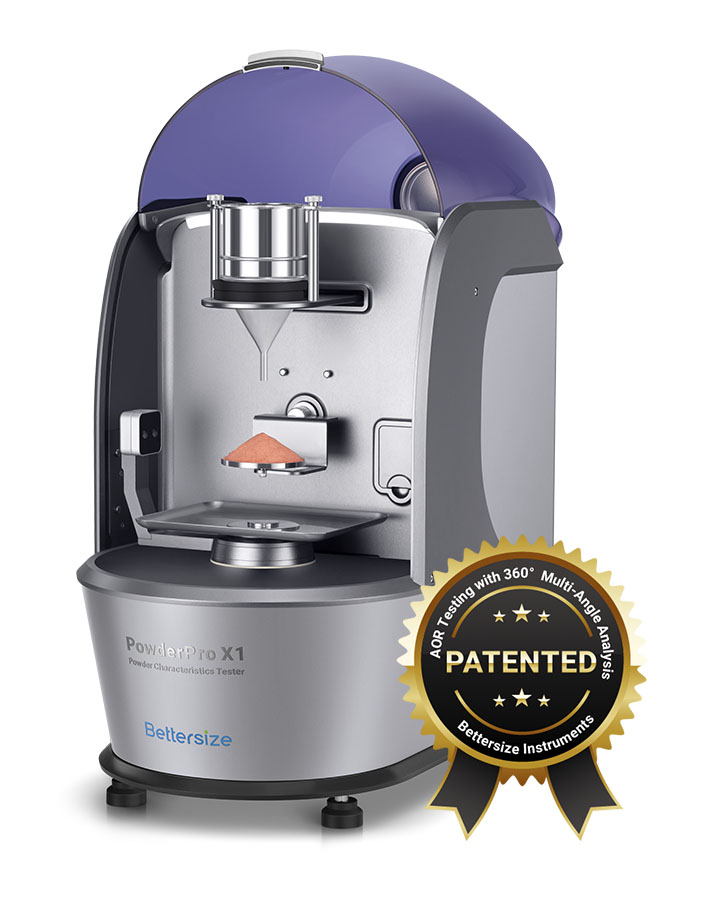
PowderPro X1 was used for all measurements. Its 360° Multi-Angle Imaging System rotates a horizontal camera through 180° around the powder pile, capturing opposite profiles at each position and generating a complete 360° azimuthal angle-of-repose distribution. This approach enables characterization of directional variations in pile geometry that cannot be observed from a single side-view measurement.
In addition to angle-of-repose analysis, the instrument evaluates powder behavior following controlled disturbance, on an inclined blade surface, and against selected contact materials, providing measurements of Angle of Fall, Angle of Difference, Angle of Spatula, and Angle of Sliding Friction within a single test platform.
Materials
|
Material |
Role in Study |
Typical Characteristics |
Industry Relevance |
|
Fine calcium carbonate |
Model asymmetric powder |
Fine particles, irregular morphology, moderate cohesion |
General powder processing; method demonstration |
|
Ti alloy AM powder |
Metallic reference powder |
Mostly spherical particles, relatively uniform packing and flow |
Powder-bed fusion, powder feeding, and recoating |
Test Parameters
|
Parameter |
What It Describes |
Interpretive Value |
|
360° Angle of Repose |
Natural pile slope across all azimuth directions |
Mean flow tendency, directional variation, and pile symmetry |
|
Angle of Fall |
Pile slope after a controlled disturbance |
Stability of the formed structure |
|
Angle of Difference |
Angle of Repose minus Angle of Fall |
Sensitivity to collapse or rearrangement |
|
Angle of Spatula |
Powder retained on a blade after lifting |
Cohesion, adhesion, and resistance to shear |
|
Angle of Sliding Friction |
Onset of sliding against a contact surface |
Powder–wall friction and discharge behavior |
Each material was conditioned and tested under the same laboratory environment.
RESULTS AND DISCUSSION
1. Angle of Repose Depends on Viewing Direction
The calcium carbonate pile exhibited a visibly less symmetric shape than the Ti alloy powder pile. Across the 360° azimuthal measurement, its angle of repose varied by 14.60°, ranging from 27.09° to 41.69°. Consequently, a conventional single-view measurement could produce substantially different results depending on the selected viewing direction. While each value accurately represents a specific cross-section of the pile, no individual measurement fully captures the overall pile geometry. By continuously acquiring measurements around the pile, PowderPro X1 overcomes this limitation and provides a complete characterization of directional variability.
Figure 1 illustrates the angle-of-repose distribution across the full 360° azimuthal range for both materials. The calcium carbonate powder exhibits pronounced directional variation, reflecting an asymmetric pile structure and non-uniform particle rearrangement. In contrast, the Ti alloy powder shows minimal variation across the measured directions, indicating a more symmetric pile shape and a more uniform packing structure.
The much narrower distribution observed for the Ti alloy powder suggests that angle-of-repose measurements obtained from different viewing directions would yield similar results. For calcium carbonate, however, the significant directional dependence highlights the risk of relying on a single side-view image when evaluating powder flow behavior.
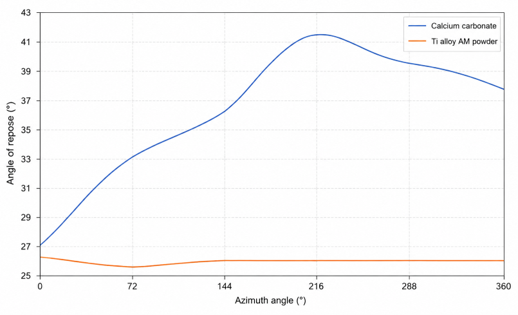
Figure 1. Representative 360° azimuthal angle-of-repose distributions.
Representative angle-of-repose values extracted from five azimuthal positions are shown in Table 1. By combining depth imaging with automated 180° camera rotation, the system reconstructs the complete 360° angle-of-repose profile, enabling quantitative evaluation of directional variations in pile geometry that cannot be captured by a single side-view measurement.
Table 1. Representative angle-of-repose results extracted from the 360° azimuthal measurement.
|
Camera Angle |
No.1 |
No.2 |
No.3 |
No.4 |
No.5 |
Average |
|
Calcium carbonate |
 |
 |
 |
 |
 |
|
|
Results |
27.09° |
31.92° |
36.17° |
41.69° |
39.65° |
35.30° |
|
Ti alloy powder |
 |
 |
 |
 |
 |
|
|
Results |
26.52° |
25.91° |
26.13° |
26.13° |
26.11° |
26.16° |
Calcium carbonate exhibited pronounced directional variation, with an angle of repose ranging from 27.09° to 41.69° and an average value of 35.30°. The approximately 15° difference between viewing directions indicates an asymmetric pile structure, demonstrating that a single side-view measurement may not accurately represent the overall flow behavior of the powder.
In contrast, the Ti alloy AM powder produced highly consistent values across all measured positions, ranging from 25.91° to 26.52° with an average value of 26.16°. The narrow variation reflects a more symmetrical pile shape and more uniform packing behavior.
The comparison highlights the advantage of 360° azimuthal analysis. While a conventional single-view measurement provides information from only one cross-section of a powder pile, the multi-angle imaging approach captures the full three-dimensional variability of the pile, revealing directional differences and structural asymmetries that would otherwise remain undetected.
2. Complementary Angle Measurements Reveal Flow-Related Mechanisms
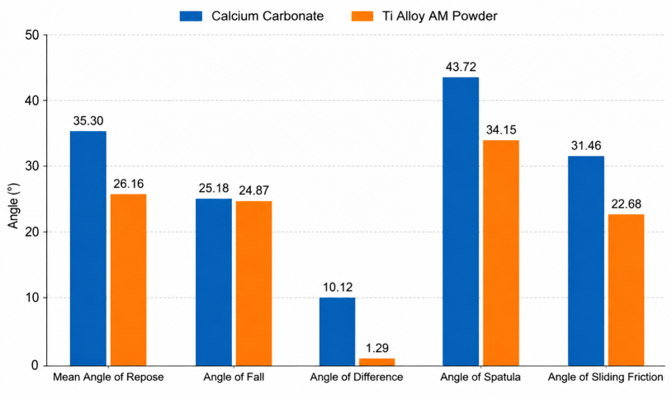
Figure 2. Comparison of complementary angle measurements.
Table 2. Comparison of angle measurements for calcium carbonate and Ti alloy AM powder.
|
Parameter |
Calcium Carbonate (°) |
Ti Alloy AM Powder (°) |
|
Mean Angle of Repose |
35.30 |
26.16 |
|
Angle of Fall |
25.18 |
24.87 |
|
Angle of Difference |
10.12 |
1.29 |
|
Angle of Spatula |
43.72 |
34.15 |
|
Angle of Sliding Friction |
31.46 |
22.68 |
The additional angle measurements help explain the differences observed in the 360° angle-of-repose distributions. Calcium carbonate exhibited a substantially larger Angle of Difference (10.12°), indicating greater structural rearrangement after disturbance and lower pile stability. Its higher Angle of Spatula value (43.72°) suggests stronger cohesive and adhesive interactions that increase resistance to powder movement.
Similarly, the higher Angle of Sliding Friction measured for calcium carbonate (31.46° versus 22.68°) indicates stronger interaction between the powder and contact surfaces. Powders with higher sliding friction require steeper inclinations to initiate motion and may exhibit increased resistance during handling, discharge, transport, and spreading operations.
By comparison, the Ti alloy powder exhibited lower values across all complementary angle measurements, consistent with more uniform particle packing, reduced interparticle resistance, and smoother interaction with contact surfaces. These characteristics are advantageous in additive manufacturing applications, where consistent feeding and uniform powder spreading are critical to process stability.
3. Why This Matters in Additive Manufacturing
- A powder may exhibit an acceptable Angle of Repose while still demonstrating significant directional variability, pile instability, or strong surface friction effects. Such characteristics can influence real-world process performance and may contribute to inconsistent powder delivery, uneven layer spreading, localized density variations, or recoating defects.
- A multi-angle characterization approach supports several practical applications:
- Incoming material qualification: Monitor both the mean angle and distribution width to identify batch-to-batch variability.
- Powder reuse evaluation: Detect changes in symmetry, cohesion, or powder–surface interactions resulting from repeated use, oxidation, or contamination.
- Process troubleshooting: Differentiate between poor intrinsic flowability, instability following disturbance, and excessive friction against process surfaces.
- Supplier comparison: Evaluate differences between nominally equivalent powders using a broader set of flow-related parameters.
CONCLUSION
A single angle-of-repose measurement may not adequately describe powders that form asymmetric piles. In this study, calcium carbonate exhibited a wide 360° angle-of-repose distribution ranging from 27.09° to 41.69°, whereas the Ti alloy powder showed a much narrower range of 25.91° to 26.13°. The corresponding distribution statistics revealed directional variability that would not be apparent from a conventional single-view measurement.
Complementary measurements, including Angle of Fall, Angle of Difference, Angle of Spatula, and Angle of Sliding Friction, further explained differences in pile stability, particle interactions, and powder–surface behavior. Together, these parameters provide a more complete understanding of powder flow mechanisms than Angle of Repose alone.
The broader implication is that powder flow should be evaluated as a multidimensional material characteristic rather than a single-number property. By combining 360° azimuthal angle-of-repose analysis with complementary flow measurements, PowderPro X1 establishes a stronger link between laboratory characterization and practical operations such as feeding, discharge, spreading, and recoating. This approach can support raw-material qualification, powder reuse studies, supplier comparisons, and long-term process control through monitoring of both average flow behavior and directional variability.
About the Author
 |
Feiqing Shen Application Engineer @ Bettersize Instruments |
|
|
PowderPro X1 18-in-1 Powder Characteristics Tester
|