How to Choose a Nanoparticle Size Analyzer for Dispersion Stability
2026-05-13News

How to Choose a Nanoparticle Size Analyzer for Dispersion Stability
Nanoparticle dispersions operate within a finely balanced system where Brownian motion, gravitational forces, and intermolecular interactions determine particle movement, collision frequency, and ultimately the stability of dispersion. Dispersion stability emerges only when repulsive forces, such as electrostatic double-layer repulsion and steric hindrance, are sufficient to counter aggregation and sedimentation over time. Consequently, reliable evaluation of dispersion stability cannot depend on particle size alone. Instead, a suitable nanoparticle size analyzer must be applied that can go further, enabling researchers to identify the underlying mechanisms governing particle interactions, aggregation, and sedimentation and predict long-term dispersion stability through sensitive, multi-parameter measurement.
Sensitivity and the Detection of Trace Aggregation
Early-stage instability rarely presents as obvious particle growth. Instead, it typically arises from a small fraction of aggregates that can escape detection and affect the stability of the dispersion system.
Why Detection Sensitivity Matters for Dispersion Stability
The initial aggregates form the large particle tail within a size distribution, representing a small population of particles significantly larger than the primary size fraction. These larger particles can act as nucleation points for further aggregation, increasing collision efficiency and accelerating cluster growth. Over time, this aggregate-driven size increase compromises the stability of the dispersion, eventually leading to sedimentation or phase separation.
Instrument Features That Enable High Sensitivity
Close attention must be paid to the optical system of the nanoparticle size analyzer, as it determines the sensitivity and accuracy of the particle size measurements critical to dispersion stability analysis. Key features of the optical system should include:
● High signal-to-noise ratio detectors
● Advanced photon counting technology, such as avalanche photodiodes (APDs)
● Stable laser sources for consistent scattering intensity.
Together, these components enable the nanoparticle size analyzer to detect subtle changes that directly influence system stability, including the emergence of a large-particle tail and early-stage aggregation.
How Sensitivity Improves Stability Analysis
High sensitivity allows researchers to detect instability at its earliest stage. This strengthens dispersion stability characterisation by enabling timely formulation adjustments, such as optimizing surfactant concentration or ionic strength to control aggregation behavior. As a result, the nanoparticle size analyzer supports predictive control over dispersion stability rather than reactive troubleshooting.
Assessing Electrostatic Barriers via Zeta Potential
Dispersion stability reflects the balance between competing interparticle forces, where Van der Waals attractions encourage aggregation, while electrostatic repulsion generates an energy barrier that prevents particles from coming into close contact.
Why Zeta Potential Is Critical for Dispersion Stability
Zeta potential provides a quantitative indicator of surface charge and interparticle repulsion, making it a core parameter for evaluating stability:
● High absolute values indicate strong electrostatic repulsion and improved dispersion stability
● Low absolute values suggest weak repulsion and increased aggregation risk.
Measurement Technologies and Their Impact
Accurate evaluation of dispersion stability necessitates the use of measurement techniques capable of resolving subtle differences in electrophoretic mobility, particularly in complex or high-conductivity systems. Phase Analysis Light Scattering (PALS) provides such a capability, offering distinct advantages in demanding applications like pharmaceutical formulations and complex colloidal systems with low electrophoretic mobility:
● Higher resolution at low electrophoretic mobility
● Improved accuracy in complex or high-conductivity media
● Reduced sensitivity to noise.
Instrument Requirements for Reliable Charge Analysis
An effective nanoparticle size analyzer should:
● Measure zeta potential in high-conductivity environments
● Handle structurally complex formulations
● Maintain accuracy across a wide mobility range.
These analytical features ensure the reliable determination of dispersion stability under realistic conditions, enabling the accurate prediction of system behavior.
Minimizing Sample Alteration Through Concentration Range
Dynamic Light Scattering (DLS), a widely used technique for nanoparticle size analysis, often requires dilution to minimize multiple scattering in concentrated systems. Unfortunately, dilution can introduce unintended variability and distort stability measurements.
Why Dilution Compromises Stability Measurement
Dilution alters key physicochemical parameters of the dispersion, including:
● Ionic strength
● Particle interaction dynamics
● pH.
This leads to the misrepresentation of true dispersion stability and reduces the reliability of nanoparticle size analyzer results.
Technologies That Enable Native-State Measurement
A nanoparticle size analyzer equipped with a backscattering measurement configuration, where detection occurs at approximately 173°, addresses such a limitation. It:
● Minimizes multiple scattering effects
● Enables the analysis of concentrated samples
● Preserves native dispersion stability conditions.
Benefits of Measuring Samples in Their Native State
Maintaining the original physicochemical state of the dispersion ensures that dispersion stability is assessed under representative conditions, thereby improving measurement accuracy, the reliability of shelf-life prediction, and the correlation between nanoparticle size analyzer measurements and real-world performance.
Environmental Stress Testing and Trend Analysis
Dispersion stability evolves under changing environmental conditions. Temperature shifts, pH variation, and external stressors all influence particle behavior over time.
Why Static Measurements Are Not Enough for Dispersion Stability
A single, static measurement of particle size or zeta potential provides limited insight into dispersion stability, requiring a nanoparticle size analyzer to evaluate how systems respond dynamically to environmental changes.
Instrument Capabilities for Controlled Stress Testing
A nanoparticle size analyzer should feature the following for reliable dispersion stability analysis:
● Precise temperature control
● Compatibility with automated titration systems
● Programmable experimental workflows.
How Trend Analysis Reveals Stability Behavior
Advanced software strengthens dispersion stability characterization by enabling:
● Mapping of particle size and zeta potential across temperature ranges
● pH sweeps to identify transition thresholds
● Automated determination of the isoelectric point.
Consequently, the nanoparticle size analyzer can determine conditions that enhance or compromise dispersion stability, advancing both formulation optimization and scale-up.
Confident Dispersion Stability Analysis with Bettersize Instruments
The choice of nanoparticle size analyzer directly influences the quality of insight gained into dispersion stability. Combining high-sensitivity particle sizing, accurate zeta potential measurement, and analysis under native conditions, the BeNano Series from Bettersize Instruments reveals the mechanisms governing stability. This enables more reliable data interpretation and informed decision-making during product development and production scaling. Speak with the experts from Bettersize Instruments and learn how the BeNano Series can improve your dispersion stability analysis.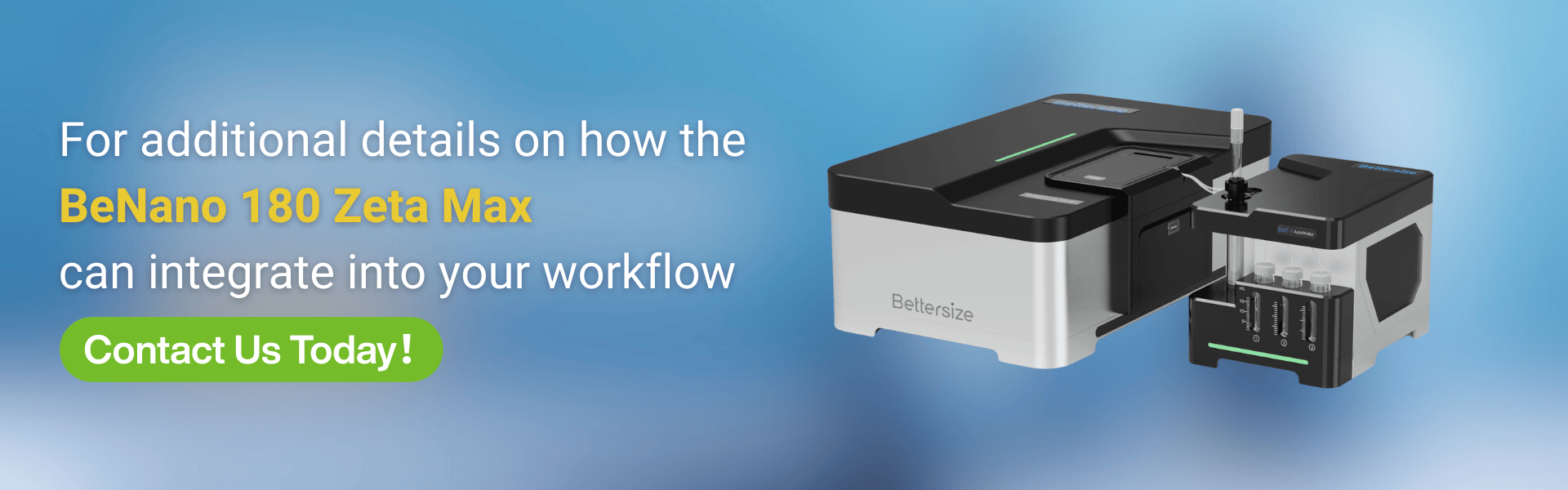
Rate this article
Share On


Recent News