From Nanoscale Dynamics to Macroscopic Stability — The Full Colloid Story at ECIS 2026
2026-08-21Exhibitions
 September 6–11, 2026 | PTS – Universidad de Granada, Granada, Spain
In colloid and interface science, the difference between a breakthrough and a failed experiment often comes down to what you can't see.
A micelle that looks monodisperse by DLS may already be aggregating. A formulation that appears stable today could be creaming invisibly. And the zeta potential you measured at one angle might not tell the whole story.
At ECIS 2026 in Granada, we're bringing two instruments that together close those gaps — one that probes nanoscale interactions with multi-angle precision, and one that watches macroscopic stability unfold without touching your sample. Whether you're tuning surfactant self-assembly, debugging a Pickering emulsion, or pushing a protein formulation toward the clinic, the data you need is within reach.
Complete Dispersion Characterization
From Nanoscale Interactions to Macroscopic Stability
BeNano 180 Zeta Max
When You Need the Nanoscale Truth — Not Just an Average
The problem: One angle, one number — but polydisperse, charged, or weakly scattering colloids rarely behave like ideal spheres. You miss aggregates, get misleading zeta values, and waste precious samples across multiple instruments.
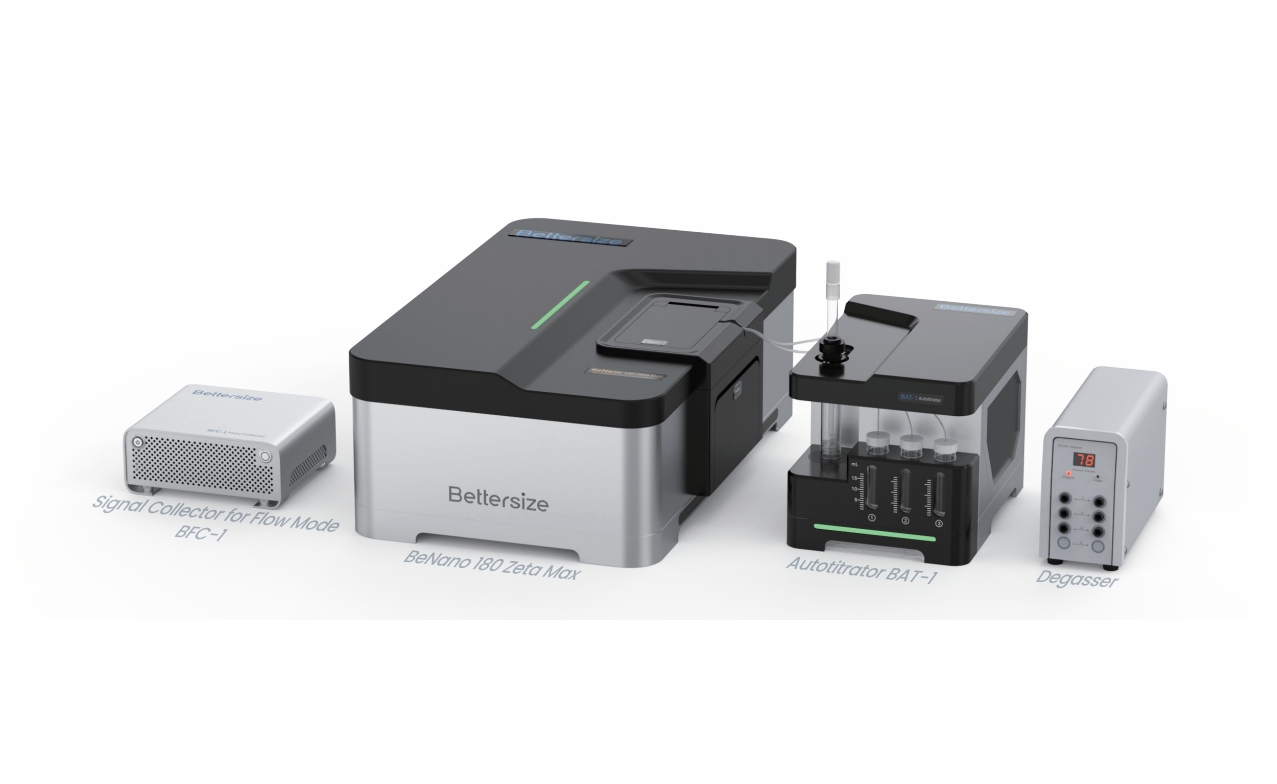
- ● 4 detection angles (173° / 90° / 12° / 0°) — cross-validate size & zeta; patented 0° detector catches weakly scattering samples
- ● 6-in-1 from one 3 μL sample — size, zeta, molecular weight, concentration, microrheology, refractive index
- ● Sedimentation mode to ~50 μm — nano to micron in one run via Stokes' law
- ● -15°C to 120°C control — thermal transitions & aggregation in real time
✨ One sample. One run. Six parameters. No more guessing what your "average" hides.
BeScan Lab+
When Stability Takes Weeks — But You Need Answers This Week
The problem: You wait weeks for a formulation to separate, only to discover it too late. And if your sample is concentrated or viscous, dilution changes the very behavior you're studying.
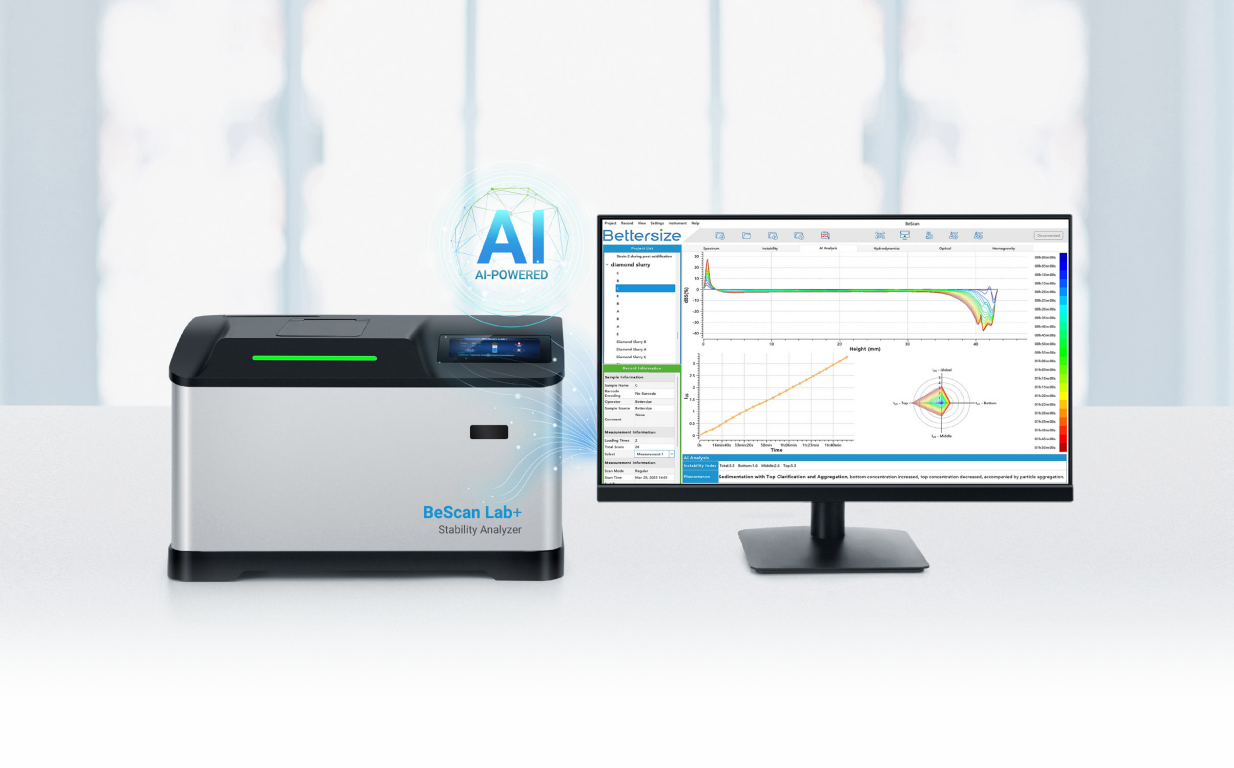
- ● Non-destructive SMLS — no dilution, no shear — measure as-is up to 95% v/v; emulsions, suspensions, foams, gels
- ● 20 μm scanning resolution (0° transmittance + 135° backscatter) — catch creaming, sedimentation, flocculation days before the eye can
- ● Up to 80°C — accelerate destabilization, predict shelf life in days not months
- ●Up to 10 units in parallel — high-throughput formulation screening
- ● ISO/TR 18811, ISO/TR 13097, ISO 13317-3 compliant — publishable, reproducible results that reviewers trust.
✨ Don't wait for separation. Watch it happen — quantitatively, in real time.
Two Instruments. One Complete Picture.
| BeNano 180 Zeta Max | BeScan Lab+ | |
| Answers | Why is it behaving this way? (mechanism) | What happens over time? (outcome) |
| Scale | 0.3 nm – ~50 μm | 0.01 – 1,000 μm |
| Sample state | Dilute, well-dispersed | As-formulated, up to 95% v/v |
| Key pain solved | Single-angle bias, limited parameters, sample waste | Slow stability testing, dilution artifacts, late detection |
| Together | Understand the nanoscale cause — and predict the macroscopic consequence. | |
Why Visit Bettersize in ECIS 2026?
✔ Bring your hardest sample — whether it's a low-scattering microemulsion, a concentrated paste, or a formulation that keeps separating for no obvious reason. Our application specialists will help you figure out which technique (or combination) gives you the answer.
✔ See both technologies run live — watch multi-angle DLS resolve a tricky sample, and see SMLS catch instability you'd otherwise miss.
✔ Talk methods, not specs — from choosing the right scattering angle to designing an accelerated stability study, we're here for the technical conversation.
✔ Guidebooks & gifts — pick up our colloid characterization guide and a little something for the trip home.
Can't Make It to Granada?
Contact us to schedule a personalized online demo, or send us up to three samples for free analysis in our European labs.
ECIS 2026— from nanoscale cause to macroscopic consequence. See you in Granada.
Rate this article
Share On


Recent News