
Key features to look for in a submersible particle size analyzer
2025-11-26News
A comprehensive investigation into sediment dynamics necessitates the use of precise, high-frequency particle size distribution (PSD) and suspended sediment concentration (SSC) measurements. Since sediment transport processes often unfold rapidly and under shifting hydrodynamic conditions, reliable in-situ measurements are crucial for capturing variations in PSD and SSC as they occur. A submersible particle size analyzer measures PSD and SSC directly in the water column, avoiding the artefacts and delays associated with discrete sampling. The key features of a submersible particle size analyzer can determine its suitability for a given application. When these features are aligned with field requirements, a submersible particle size analyzer can maintain accuracy and stability even as turbidity, flow, and pressure conditions vary in real-world aquatic environments.
Key Features of Submersible Particle Size Analyzers
Measurement range and resolution
A capable submersible particle size analyzer must capture the full spectrum of particles found in natural water bodies. It should measure from the smallest clay particles to larger sand grains or aggregates, typically within 0.1 µm to 2000 µm.
Key considerations:
- Particle size range- Wide enough to cover fine and coarse sediments.
- Suspended sediment concentration (SSC) range- Should operate reliably from 0.001 g/L to 100 g/L to handle clear and turbid water.
- Resolution- Instruments with a high number of closely spaced size bins provide much more detailed PSD outputs, capturing subtle variations in particle populations.
- Measurement consistency- The submersible particle size analyzer must deliver reliable data even as particle densities, concentrations, and flow conditions change.
By offering a broad, high-resolution measurement range, a submersible particle size analyzer provides accurate, comparable results across dynamic environmental settings.
Optical measurement system
The optical system of a submersible particle size analyzer determines how effectively it can detect and classify particles. Submersible particle size analyzers typically rely on techniques like laser diffraction, which calculate particle size from the angular distribution of scattered light to produce stable, quantitative particle size distributions even when sediment loads shift rapidly in the field.
Key features:
- Laser source- A stable, monochromatic laser (typically 635 nm, 10 mW) that offers strong, consistent illumination.
- Detector array- Multi-angle detector setup, such as 80 detectors covering 0.0163° to 42°, for accurate size resolution.
- Optical path length- Adaptive path systems that adjust to changing turbidity levels, ensuring reliable measurements as sediment concentrations fluctuate.
A well-engineered optical configuration defines the submersible particle size analyzer’s precision and resilience, even in dynamic, sediment-rich environments.
Depth rating and structural design
Field conditions can be unpredictable, and a submersible particle size analyzer must perform consistently under pressure and temperature variation.
What matters most:
- Depth rating- The submersible particle size analyzer should exceed the maximum expected deployment depth, with 200 m being a strong benchmark for dependable field performance.
- Pressure stability- Hydraulic pressure-compensation chambers and rigid optical support structures can preserve alignment under increasing hydrostatic pressure.
- Temperature tolerance- Insulated housings, temperature-compensated optics, and wide-range electronics maintain performance across thermoclines and seasonal changes.
Robust construction protects the submersible particle size analyzer's optical and electronic components, enabling stable, long-term operation and reliable measurements over extended deployments.
Anti-fouling and window maintenance
Fouling from algae, sediment, and biofilm is one of the biggest challenges in underwater optical measurement, particularly for a submersible particle size analyzer. Without mitigation, it quickly reduces data quality.
Key features:
- Automatic optical window cleaning- Integrated wipers or scrapers remove deposits during operation.
- Low-maintenance design- Reduces manual cleaning requirements during long deployments.
These features are central to reliable field performance as clean optical windows help maintain consistent data accuracy and reduced maintenance downtime.
Integrated environmental sensors
Integrated environmental sensors upgrade the capabilities of submersible particle size analyzers by adding contextual information, like depth, temperature, conductivity, and turbidity, which supports the interpretation of PSD and SSC data.
Key integrated sensors:
- Depth and pressure sensors- Provide the vertical position information required to profile conditions across different water layers.
- Temperature and conductivity sensors- Measure thermal and salinity conditions that define water mass properties.
Combining particle and environmental measurements allows users to relate changes in PSD and SSC to variations in flow, salinity, and temperature, delivering clearer insight into the factors influencing sediment behavior.
Data handling and power management
Effective data handling and energy efficiency determine how practical a submersible particle size analyzer is for field deployment.
Key features:
- Onboard data storage- Supports autonomous, long-term monitoring.
- Multiple communication options- Wired, 4G wireless, and offline download modes give users greater flexibility when accessing, transferring, or managing collected data.
- Low power consumption- Enables longer deployment without recharge or maintenance.
Well-designed data and power systems in submersible particle size analyzers reduce operational demands and strengthen the productivity of each monitoring effort.
Precision Begins with the Right Analyzer
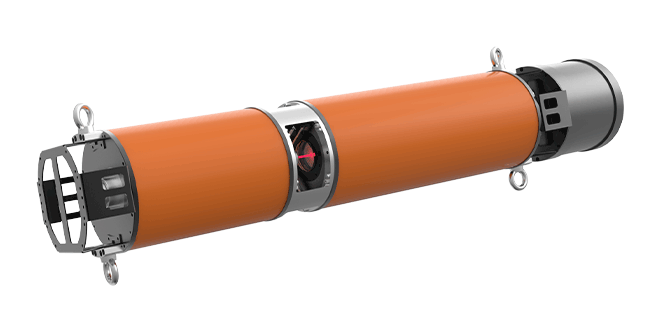
The features of a submersible particle size analyzer determine its ability to generate reliable measurements in dynamic aquatic environments. With its combination of advanced optics, durable structural design, and integrated environmental sensing, the DeepSizer 300, a submersible particle size analyzer from Bettersize Instruments, exemplifies the capabilities required for consistent in situ sediment analysis. It measures particle sizes from 0.1 µm - 2000 µm and suspended sediment concentrations from 0.001 g/L to 100 g/L, using a polarized 635 nm laser and an 80-detector array to resolve fine variations in particle populations.
Differential Path Technology and Adaptive Path Technology sustain data quality as turbidity changes, while automated window cleaning helps maintain clear optical pathways during long deployments. All of these features ensure dependable measurements in challenging settings. For more information on our DeepSizer 300 and to see how it can enhance your monitoring strategy, contact our specialists today!
LOGIN TO ACCESS EXCLUSIVE CONTENT
More Resources Including
- Application Notes & Collections
- Webinars & Workshops
- Presentations & Videos
- Monthly Newsletters
- Exclusive Events...

Recommended articles
Rate this article