
Concentration Measurement of Polystyrene Microspheres with the BeNano 180 Zeta Max
2025-05-15Application Note
This application note presents the measurement of particle size and concentration of polystyrene microspheres dispersed in water using the BeNano 180 Zeta Max.
| Product | BeNano 180 Zeta Max |
| Industry | Chemicals |
| Sample | Polystyrene Spheres |
| Measurement Type | Particle Shape and Particle Concentration |
| Measurement Technology | Light Extinction—Dynamic Light Scattering (LEDLS) |
Jump to a section:
Introduction
The measurement of particle size and concentration plays a crucial role across various industries, as it directly influences studies on physicochemical properties and reaction kinetics. These measurements are widely utilized in environmental monitoring, industrial quality control, medical diagnostics, and food production.
Several techniques can be employed to assess particle concentration, including light scattering, light obscuration, and electrical resistance methods. The BeNano 180 Zeta Max, a nanoparticle size and zeta potential analyzer developed by Bettersize, features the patented LEDLS (Light Extinction and Dynamic Light Scattering) technique. This advanced method enables precise measurements of particle volume fraction and number concentration over a broad size range. As an innovative approach, LEDLS eliminates the need for toluene calibration before measurement, simplifies the operation, and allows for single-angle concentration analysis.
This application note presents the measurement of particle size and concentration of polystyrene microspheres dispersed in water using the BeNano 180 Zeta Max.
Experimental
This study analyzed monodisperse polystyrene spheres with diameters of 20 nm, 50 nm, 100 nm, 300 nm, and 500 nm. The concentration range varied from 0.00025% to 2.5%. The dilution process was carried out using a gravimetric method to ensure accuracy. The refractive index and absorption of the polystyrene spheres were 1.59 and 0.001, respectively. Each sample was measured three times, and the average result was recorded.
Additionally, a mixed sample was prepared, consisting of 0.1% 60 nm polystyrene spheres and 0.01% 200 nm polystyrene spheres for concentration analysis.
Results and Discussion


A concentration analysis was conducted on a mixed sample containing 60 nm and 200 nm polystyrene spheres. The result on figure 3 presents tested by Bettersize BeNano 180 Zeta Max two distinct peaks at 64 nm and 198 nm, with the narrow peak widths attributed to a high-resolution algorithm. The theoretical volume fractions for the 60 nm and 200 nm samples were 0.1% and 0.01%, corresponding to theoretical number concentrations of 8.84E+12 and 2.39E+10 particles/mL. The measured values were 0.101% and 0.0034% for volume fraction and 9.62E+12 and 1.10E+10 particles/mL for number concentration. The discrepancy in the measured concentration of the 200 nm spheres is likely due to their low proportion in the mixture.

Figure 2 compares theoretical and measured concentration values for polystyrene spheres ranging from 20 nm to 500 nm across various concentrations. The x-axis represents theoretical concentration, while the y-axis denotes the number concentration obtained using the BeNano 180 Zeta Max. The results demonstrate a strong correlation between theoretical and measured concentrations, spanning from 1E+7 to 1E+16 particles/mL.
The accuracy of particle concentration measurements depends on particle size and optical properties. Generally, small particles (<100 nm) with weak scattering perform optimally at higher concentrations. Particles within the 100 nm–400 nm range offer a broader applicable concentration window, whereas larger particles (>400 nm) are suitable only within a limited concentration range. At low concentrations, number fluctuations may occur, while high concentrations of large particles can lead to multiple scattering effects, both of which impact measurement accuracy.
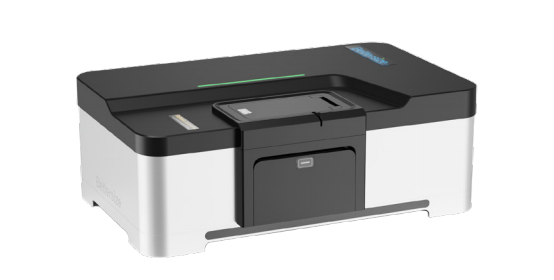
BeNano 180 Zeta Max


A concentration analysis was conducted on a mixed sample containing 60 nm and 200 nm polystyrene spheres. Figure 3 presents two distinct peaks at 64 nm and 198 nm, with the narrow peak widths attributed to a high-resolution algorithm. The theoretical volume fractions for the 60 nm and 200 nm samples were 0.1% and 0.01%, corresponding to theoretical number concentrations of 8.84E+12 and 2.39E+10 particles/mL. The measured values were 0.101% and 0.0034% for volume fraction and 9.62E+12 and 1.10E+10 particles/mL for number concentration. The discrepancy in the measured concentration of the 200 nm spheres is likely due to their low proportion in the mixture.
Conclusion
This application note highlights the capability of the BeNano 180 Zeta Max in measuring polystyrene particle concentration using the LEDLS technique. The findings demonstrate strong agreement between measured and theoretical concentrations within the 20 nm–500 nm size range and suitable concentration limits, confirming the accuracy and reliability of the method.
About the Authors
 |
Zhibin Guo Application Manager @ Bettersize Instruments |
 |
Dr. Ning Chief Product Officer @ Bettersize Instruments |
|
BeNano 180 Zeta Max Advanced Nanoparticle Size & Zeta Potential Analyzer
|
|
LOGIN TO ACCESS EXCLUSIVE CONTENT
More Resources Including
- Application Notes & Collections
- Webinars & Workshops
- Presentations & Videos
- Monthly Newsletters
- Exclusive Events...

Recommended articles
Rate this article