Why Choose a Nanoparticle Analyzer with Integrated Particle Separation?
2026-03-24News
Why Choose a Nanoparticle Analyzer with Integrated Particle Separation?
Averages can be misleading when it comes to nanotechnology. A single mean particle size can look clean, precise, and publishable, yet still conceal the most important information in the sample. When formulations fail stability tests or biological responses vary unexpectedly, the root cause is often hidden within that average.
Traditional batch-mode techniques like Dynamic Light Scattering (DLS) or Static Light Scattering (SLS) measure an ensemble response. They report what the population looks like on average, not how many distinct populations actually exist. For monodisperse systems, this approach can be sufficient. For real-world nanoparticle systems, it is frequently misleading.
The physics explains why. Scattered light intensity scales with the sixth power of particle diameter (d⁶). A single large aggregate can scatter up to a million times more light than a well-behaved nanoparticle. In practice, this means a trace population of oversized particles can dominate the signal, masking smaller, and often more critical, species entirely.
To move beyond this limitation, researchers are increasingly shifting from ensemble measurements to integrated systems that combine particle separation with advanced optical detection. The result is not just a number, but a high-resolution fingerprint of the sample.
The Mechanics of Integrated Separation
Integrated separation changes the order of measurement. Instead of analyzing everything at once, the sample is first sorted by hydrodynamic size before it reaches the detectors. In effect, separation acts as a filter that disentangles complexity before analysis begins.
Two separation strategies dominate nanoparticle and macromolecular characterization.
Size Exclusion Chromatography (SEC) separates species as they pass through a porous column. Smaller molecules explore more pore volume and elute later, while larger species pass through more quickly. SEC is well suited for proteins, polymers, monomers, and oligomeric states where shear sensitivity is low and resolution requirements are high.
Field-Flow Fractionation (FFF) takes a different approach. It uses a narrow channel and a perpendicular cross-flow field to separate particles without a packed column. This minimizes shear stress and makes FFF particularly valuable for fragile or soft nanostructures such as lipid nanoparticles (LNPs), liposomes, and large biopolymers.
The real power emerges when separation is combined with synchronized detectors. Integrated platforms couple SEC or FFF directly with SLS, DLS, and refractive index detection. As each fraction elutes, its size, molar mass, and structural properties are measured independently, turning a complex mixture into a sequence of fully characterized components.
Benefit 1: Resolving Complex, Polydisperse Samples
Integrated separation reveals what batch analysis cannot. Samples that appear as a single broad distribution suddenly resolve into multiple, well-defined peaks.
Consider a common protein standard: human serum albumin (HSA). In batch DLS, HSA often presents as a slightly broadened peak, hinting at heterogeneity but offering little clarity. More distinct populations are defined with integrated SEC–light scattering. Monomers at 68 kDa separate cleanly from dimers, trimers, and higher-order aggregates, each quantified with its own mass fraction.
Early-stage aggregation, trace contaminants, or foreign particle populations can have outsized effects on stability, immunogenicity, or performance. High-resolution separation remains the most reliable way to detect these minor but consequential species before they become major problems.
Benefit 2: Absolute Accuracy Without “Standards”
Conventional chromatography often relies on calibration curves built from standards such as polystyrene. This approach assumes the analyte behaves like the standard, an assumption that rarely holds for real materials.
Branched polymers, rod-like copolymers, and complex biomacromolecules interact with columns differently than linear calibration standards. The result is systematic error, sometimes spanning orders of magnitude in estimated molecular weight.
Integrated systems eliminate this dependency. By combining separation with light scattering detection, molar mass and size are determined directly from first-principles light scattering theory. Measurements become independent of retention time, column aging, or drift in calibration. The data reflect the molecule itself, not how closely it resembles a reference standard.
Benefit 3: Structural and Morphological Insight
Size alone rarely tells the full story. Two nanoparticles with identical hydrodynamic diameters may behave very differently in vivo or during processing.
Integrated systems address this by measuring complementary size metrics simultaneously. DLS provides the hydrodynamic radius (Rₕ), while dual-angle light scattering yields the radius of gyration (Rᵍ). The ratio between these values, often referred to as a shape factor, offers direct insight into particle conformation.
Uniform solid spheres, flexible coils, and elongated rods each occupy distinct regions in Rᵍ/Rₕ space. This structural context is critical for understanding diffusion, cellular uptake, and drug delivery efficiency.
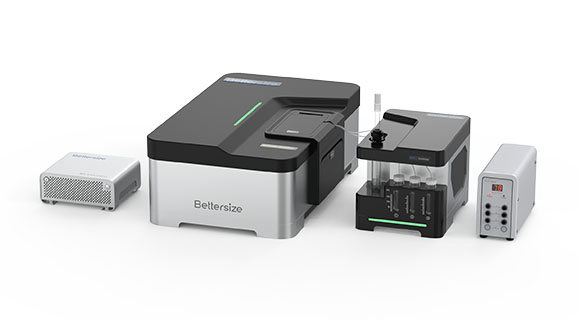
Explore the BeNano Series of nanoparticle analyzers here
From Observation to Control
Integrated particle separation transforms nanoparticle analysis from passive observation into active control. Instead of asking whether a sample meets a specification on average, researchers can understand why it behaves as it does.
For multimodal distributions, non-linear polymers, and regulated biopharmaceutical systems, integrated separation is not a luxury. It is the only practical path to clarity, confidence, and control. Exploring integrated platforms such as the BeSEC and BeNano series is a logical next step for laboratories that demand more than an average from their nanoparticle measurements.
References
- Meier, Florian & Heinzmann, Gerhard. (2017). Field-Flow Fractionation: A powerful technology for the separation and advanced characterization of proteins, antibodies, viruses, polymers and nano-/microparticles. www.chemie.de.
- Philip J. Wyatt, Light scattering and the absolute characterization of macromolecules, Analytica Chimica Acta, Volume 272, Issue 1, 1993, ISSN 0003-2670, https://doi.org/10.1016/0003-2670(93)80373-S.
- Hsieh, V.H., Wyatt, P.J. Measuring proteins with greater speed and resolution while reducing sample size. Sci Rep 7, 10030 (2017). https://doi.org/10.1038/s41598-017-09051-1
Rate this article
Share On


Recent News