How to Choose a Particle Size Analyzer
2026-01-12News
How to Choose a Particle Size Analyzer
For laboratories working with particulate systems, particle size data underpins many routine decisions, from understanding raw material behavior to maintaining batch-to-batch consistency. When those measurements are reliable, they support confident development work and stable production. But when they are not, small uncertainties can quickly become larger process issues.
A particle size analyzer (PSA) is used to measure the size distribution of particles within a sample. Modern particle size analysis instruments typically rely on Laser Diffraction (LD), Dynamic Light Scattering (DLS), or image analysis to generate this data. Although these techniques often report the Particle Size Distribution (PSD), they are based on different physical principles and are therefore not interchangeable. For example, particle size obtained by laser diffraction is expressed as an equivalent volume diameter. Selecting the right PSA is therefore not just a matter of comparing specifications. It requires matching the measurement technique to the material, the type of insight required, and the practical realities of the laboratory.
Step 1: Match the Measurement Method to the Size Range
The first step in deciding upon a PSA is defining the particle size range that must be measured. This usually comes down to understanding the expected d10 and d90 values, which mark the lower and upper ends of the particle size distribution.
For particles below 1 µm, DLS is required. At this scale, particle motion is dominated by Brownian movement, and DLS uses fluctuations in scattered light to calculate particle size. For broader size distributions, typically around several millimeters, LD is usually more appropriate, as it can measure fine and coarse particles within a single analysis.
During PSA selection, the stated measurement range should exceed the expected sample range. A margin of around 20% at both the lower and upper limits helps ensure the full distribution is captured and that d10 and d90 values are not artificially constrained.
Step 2: Choose a Dispersion Approach That Fits Your Material
The dispersion method used by a PSA directly influences whether measurements reflect individual particles or agglomerated structures. This, in turn, depends on the material's chemistry and handling characteristics. When choosing a PSA, consider if a sample requires:
- Wet dispersion- often necessary for cohesive powders that tend to form agglomerates. Here, liquids, surfactants, and ultrasonic energy are used to separate particles without changing their primary size.
- Dry dispersion- essential for water-soluble materials or if powders need to be measured in their as-received state. This approach also supports faster measurements and higher throughput due to the absence of suspension preparation.
Sample quantity can also influence instrument choice. Micro-volume measurement capabilities are valuable for limited or high-value materials, whereas industrial applications generally require higher-volume dispersion systems to achieve representative results.
Step 3: Decide How Much Insight You Need from the Data
PSA choice should be guided not only by particle size range, but also by how much detail the measurement needs to provide. In many quality control applications, such as routine batch release testing or incoming raw material checks, a consistent and repeatable size distribution defined by d10, d50, and d90 is sufficient. However, in other cases, additional insight is needed, such as during process troubleshooting, formulation development, or when investigating the cause of product defects. If process issues or product defects are linked to a small number of oversized particles, the PSA must be capable of detecting them. Dynamic image analysis supports this by enabling the direct observation and measurement of individual particles.
Particle shape can also be relevant in certain applications, as it may influence flowability, packing behavior, and wear characteristics. In cases where such effects are critical to processing or product quality, access to shape-related information, such as aspect ratio or circularity, can be beneficial, though it is not a core requirement for all PSA measurements.
Step 4: Ensure the Instrument Fits the Workflow
Beyond analytical performance, a PSA also needs to work smoothly within the day-to-day routine of the laboratory. Throughput is best judged by looking at the entire measurement cycle, including how long it takes to disperse the sample, run the measurement, and clean the system, rather than focusing on measurement time alone.
Moreover, automation and method control can help maintain consistency, especially in laboratories with multiple users. Predefined methods reduce operator-to-operator variation and make results easier to reproduce. In regulated environments such as pharmaceuticals and food science, software support for ISO 13320 and 21 CFR Part 11 is crucial for ensuring data integrity and regulatory compliance and will often narrow the range of suitable PSAs.
Discover PSAs from Bettersize Instruments
Different applications place various demands on particle size analyzers, which is why no single instrument is suitable for every laboratory. Once the requirements of the material and the analysis are clearly defined, it becomes easier to identify a PSA that fits both the technical and practical demands of the intended use.
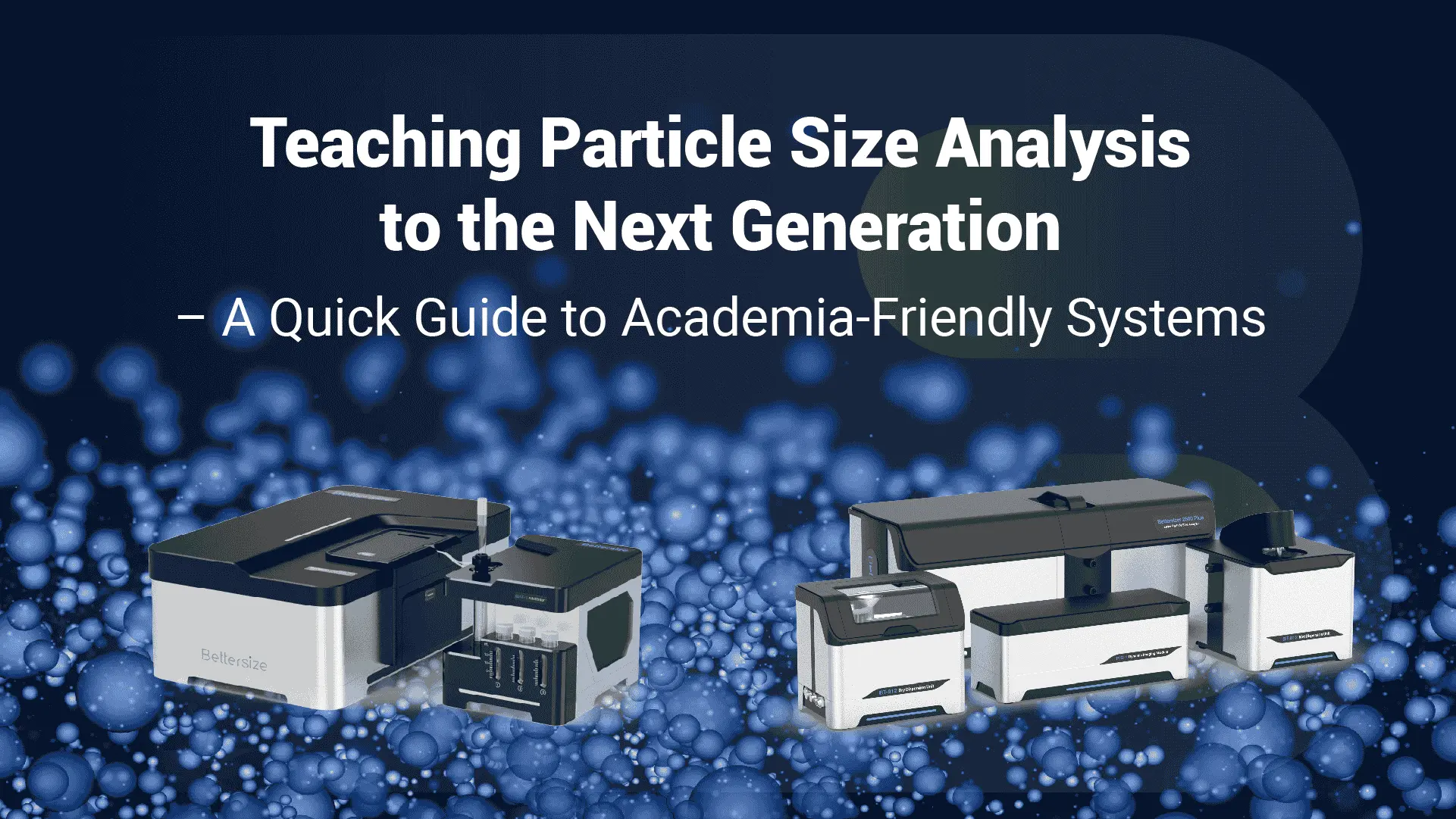
Bettersize Instruments offers a portfolio of PSAs designed to address the varying requirements of differing materials, measurement ranges, and application demands across research and industrial laboratories. The Bettersizer 2600 is a flexible solution for laboratories working with diverse materials, supporting both wet and dry dispersion by LD, with a size range from 0.02 µm to 2,600 µm in wet mode and 0.1 μm to 2,600 μm in dry mode. For areas that require greater insight into particle behavior, the Bettersize S3 Plus combines LD with high-speed dynamic imaging, providing particle size and shape data within a single measurement. For nano-scale materials and colloidal systems, the BeNano Series uses Dynamic Light Scattering to measure particle size alongside zeta potential and molecular weight, supporting studies of dispersion stability and shelf-life.
With decades of experience in particle characterization and measurement technology, Bettersize Instruments can help laboratories decide upon a PSA that delivers reliable, meaningful data. Speak with our team today to determine which PSA best fits your analytical needs.

Rate this article
Share On


Recent News