BeNano Empowers Nobel-Winning Metal-Organic Frameworks Research: Transforming MOFs into Measurable Science
2025-10-15News

MOFs, composed of metal ions linked by organic ligands, have been hailed as “designer sponges” for the molecular world. With surface areas larger than football fields per gram and tunable chemical properties, they can capture carbon dioxide, purify water, store hydrogen, and even deliver drugs precisely to targeted tissues.
But behind every MOF breakthrough lies a deeper challenge: understanding how particle size, stability, and surface charge determine real-world performance. These parameters influence how a MOF disperses in liquid, interacts with biological membranes or pollutants, and maintains functionality in complex environments. That’s where BeNano (Bettersize’s flagship nanoparticle size and Zeta Potential analyzer) becomes essential.
Measuring the Invisible Forces that Shape MOF Performance
At the intersection of nanoscience and measurement technology, the BeNano series provides precise characterization of particle size, zeta potential, and molecular interactions—key indicators of MOF quality, stability, and performance.
“MOFs are elegant molecular architectures,” said Zhibin Guo, Application Scientist at Bettersize. “To transform that elegance into reliable, real-world applications, researchers need quantifiable data — and that’s exactly what BeNano delivers.”
Dozens of research teams worldwide have integrated BeNano into their MOF workflows, bridging fundamental chemistry with applied innovation. Representative studies using BeNano in MOF characterization are listed in Table 1.
| Title | Journal | Volume | Page | DOI |
|---|---|---|---|---|
| Near-Infrared-Responsive CuS@Cu-MOF Nanocomposite with High Foliar Retention and Extended Persistence for Controlling Strawberry Anthracnose | Journal of Controlled Release | 367 | 837–47 | 10.1016/j.jconrel.2024.02.012 |
| MOF-Modified Dendrite-Free Gel Polymer Electrolyte for Zinc-lon Batteries | RSC Advances | 14, no. 22 | 15337–46 | 10.1039/D4RA02200A |
| Ultrasonic-Assisted in Situ Synthesis of MOF-199 on the Surface of Carboxylated Cellulose Fibers for Efficient Adsorption of Methylene Blue | RSC Advances | 14, no. 21 | 15095–105 | 10.1039/D4RA02099E |
| A Synergistic Polyelectrolytes-Zr-MOF Hydrated Construction Graphene Oxide Nanofiltration with Enhanced Dye Wastewater Remediation | Journal of Environmental Chemical Engineering | 12, no. 3 | 112865 | 10.1016/j.jece.2024.112865 |
| POMOF-Derived Fe₂O₃@P₂W₁₈ with SWNT Nanocomposites as Colorimetric Biosensors for Glucose | Solid State Sciences | 149 | 107472 | 10.1016/j.solidstatesciences.2024.107472 |
| MOFs/MXene Nano-Hierarchical Porous Structures for Efficient Ion Dynamics | Nano Energy | 129 | 110076 | 10.1016/j.nanoen.2024.110076 |
This report focuses on how the BeNano from Bettersize Instruments supports MOF research, illustrated through the study “Engineering Bio-MOF/Polydopamine as a Biocompatible Targeted Theranostic System for Synergistic Multi-Drug Chemo-Photothermal Therapy” published in the International Journal of Pharmaceutics.
Experimental Section
Bio-MOFs were prepared by reacting Zn(OAc)₂·2H₂O and curcumin (Cur) in an ethanol and N,N′-dimethylacetamide mixture at 120°C for 48 hours. The resulting solid was washed with DMF and vacuum-dried. Dopamine coating produced MP, which was further modified with hyaluronic acid (HA) to form MPH. Doxorubicin (DOX) was then loaded into the PDA-coated structure, and an HA shell produced the final MPDH nanoparticles.
Characterization included SEM and EDS for morphology and composition, UV–Vis, FT-IR, and fluorescence spectroscopy for optical properties, XRD for crystal structure, and BeNano for particle size and zeta potential measurements.
Results and Discussion
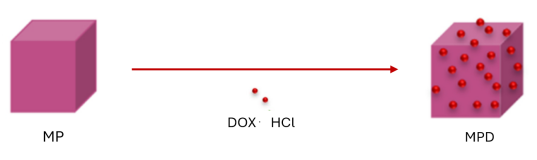
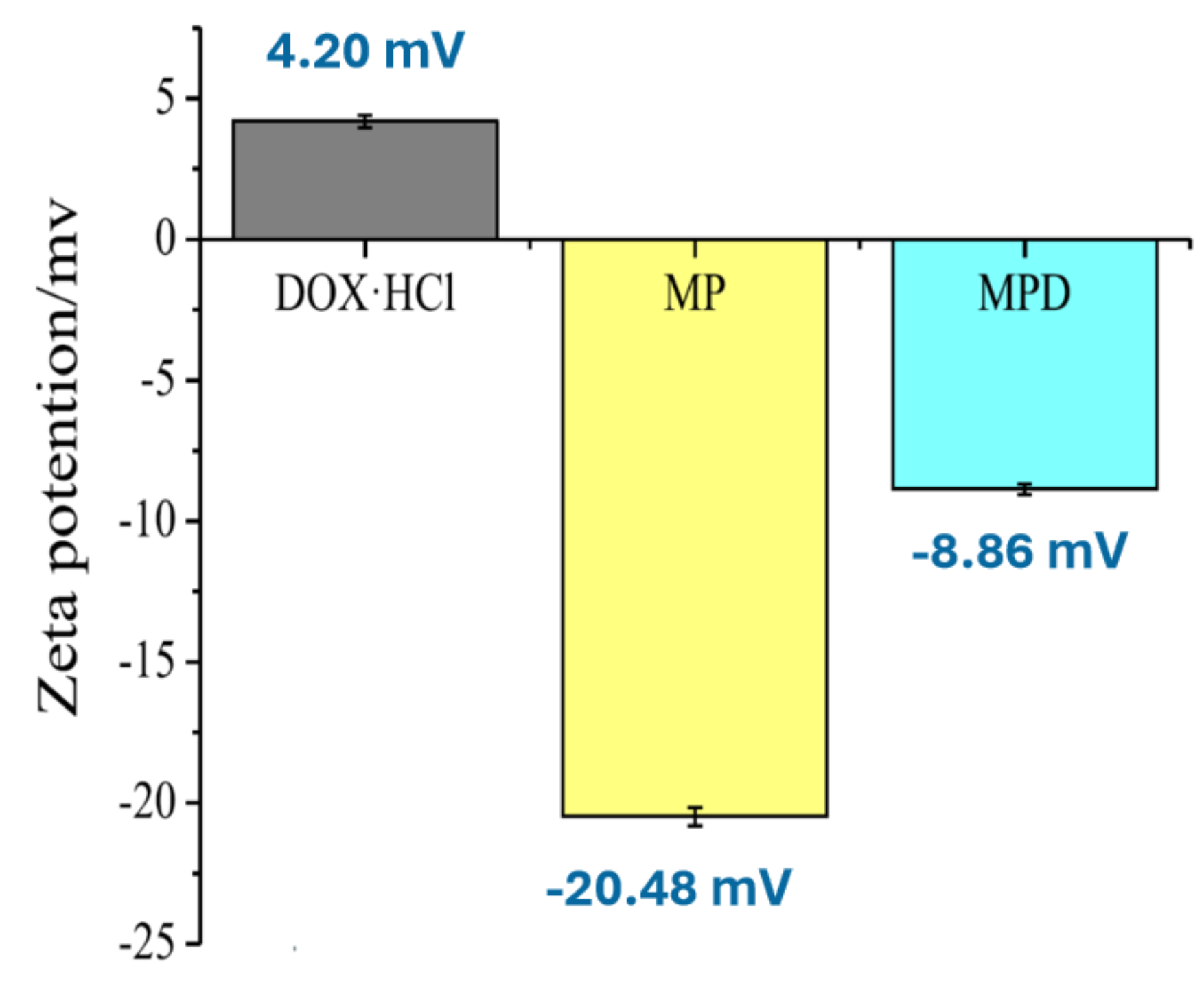
Figure 2. Transformation of MP and MPD (top) and zeta potentials of DOX·HCl, MP, and MPD (bottom).
The zeta potential of MP was -20.48 ± 0.32 mV and increased to -8.86 ± 0.19 mV after DOX·HCl loading. Since DOX·HCl carries a positive charge (4.20 ± 0.22 mV), the change in zeta potential confirms its successful loading to the MP nanoparticle surface.
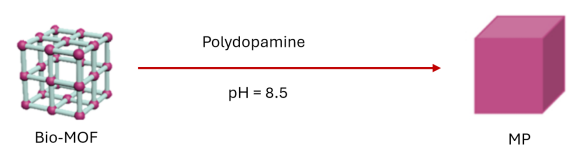
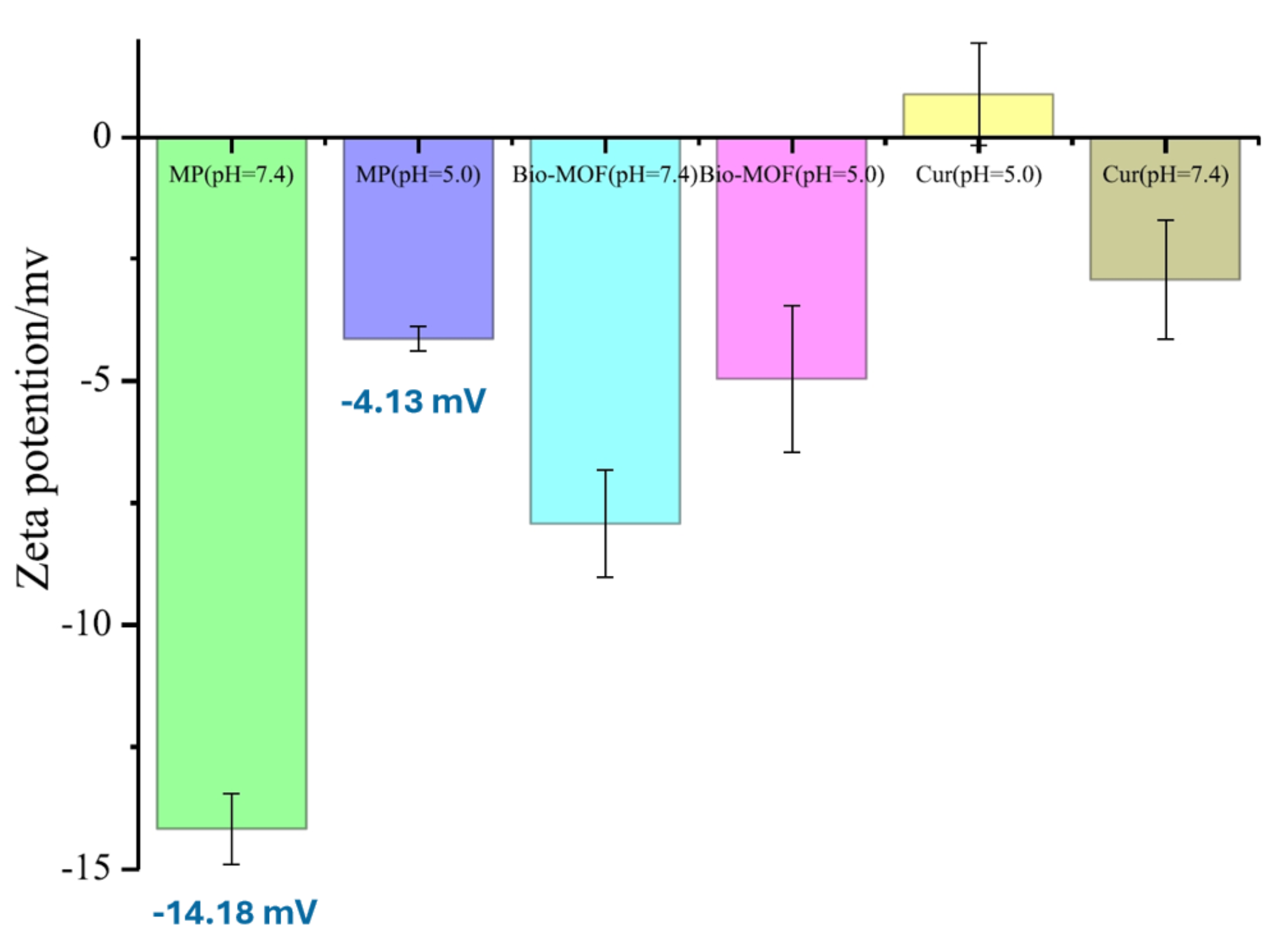
Figure 3. pH-induced transformation of Bio-MOF and MP (top) and zeta potentials under different pH conditions (bottom).
To determine whether curcumin release at low pH is linked to PDA layer detachment, zeta potentials of Bio-MOF and MP were measured at different pH levels. After 24 hours in PBS, MP’s zeta potential rose from -14.18 ± 0.73 mV (pH 7.4) to -4.13 ± 0.26 mV (pH 5.0), approaching that of Bio-MOF (pH 5.0). This observation suggests that the PDA layer detaches in acidic environments, exposing the positively charged curcumin molecules.
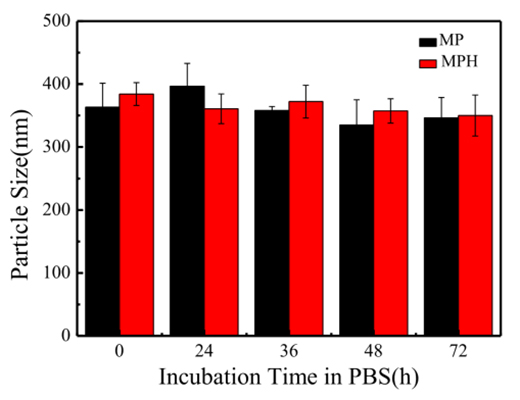
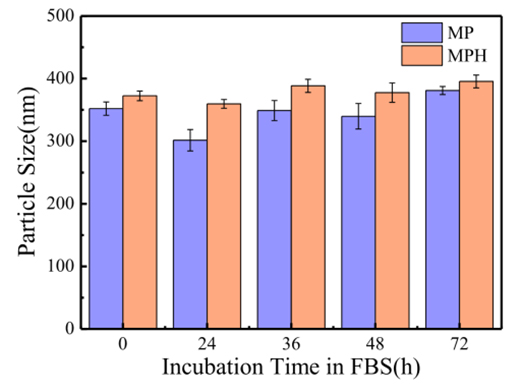
Figure 4. Size stability of MP and MPH in PBS (top) and FBS (bottom) (n = 3).
In addition to zeta potential, size characterization is equally important. Colloidal stability was assessed by incubating MP and MPH nanoparticles in PBS and FBS to simulate physiological and plasma conditions. Both samples maintained consistent size over 72 hours, showing strong resistance to aggregation caused by ionic strength (PBS) or protein adsorption (FBS). This demonstrates excellent biocompatibility and long-term stability.
This case shows how BeNano enables detailed characterization of curcumin-based Bio-MOFs and their PDA-coated forms (MP, MPH, MPDH). With accurate data on size, zeta potential, and stability, BeNano helps scientists transform Nobel-level discoveries into measurable, controllable, and dependable technologies.
From Nobel Concepts to Quantifiable Progress
The 2025 Nobel Prize in Chemistry highlighted MOFs as transformative materials for environmental and biomedical innovation. BeNano plays a pivotal role in precisely measuring their particle size and surface charge. At Bettersize, we take pride in helping researchers quantify the invisible, standardize the complex, and translate Nobel-level discoveries into measurable realities. As the global community continues exploring the limitless architectures of MOFs, BeNano stands as a trusted analytical partner — ensuring that every breakthrough is not just visionary, but verifiable.
About Bettersize Instruments:
Founded in 1995, Bettersize Instruments is a global leader in particle characterization, offering innovative solutions for particle size, zeta potential, and powder property analysis. With over 100 patents, 43 global laboratories, and 22,000+ organizations using its technology, Bettersize empowers scientific and industrial communities to understand material properties, facilitate research, improve production efficiency and beyond.
Rate this article
Share On


Recent News


2026-03-06
Teaching Particle Size Analysis to the Next Generation – A Quick Guide to Academia-Friendly Systems

2026-01-22


2026-01-12