ホーム > 製品 > Bettersizer 2600

Bettersizer 2600

お見積依頼 連絡販売
パンフレットをダウンロード

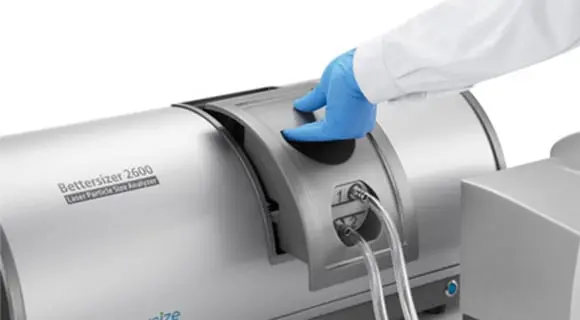
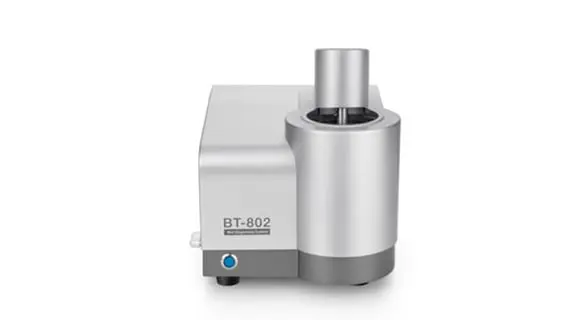
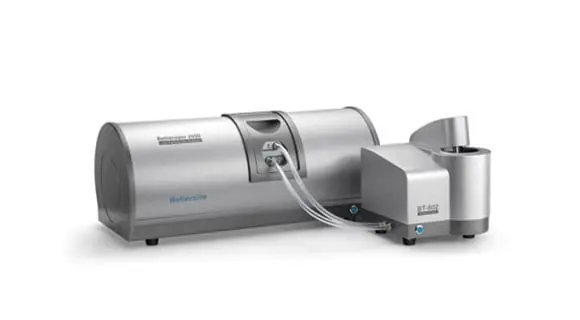
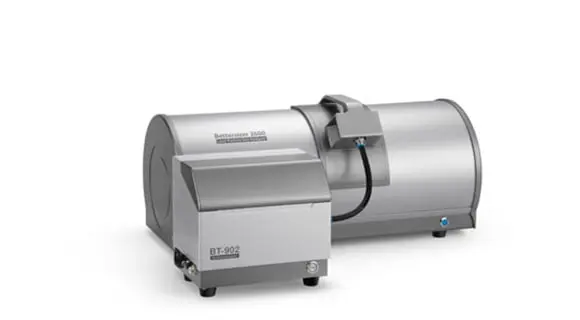
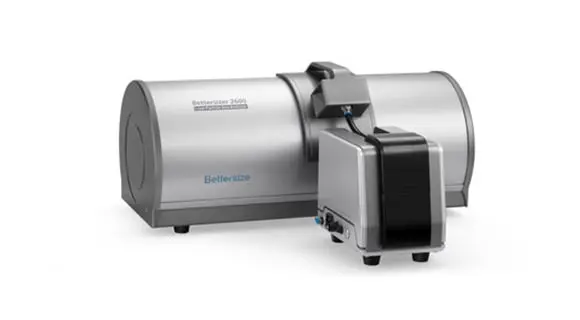
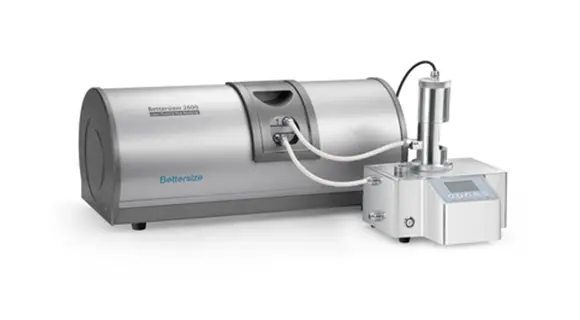
Bettersizer 2600は、レーザー回折・散乱法を採用し、0.02〜2,600 μm の広範な粒子径測定を実現する高精度粒子解析装置です。Bettersizer 2600のモジュール設計は、さまざまな粉粒体の特性に対応できる多彩なオプションを備えており、お客様の多様なニーズに柔軟にお応えします。特にレーザー回折・散乱法と湿式の動的画像解析法の組み合わせは、測定可能な粒子径範囲を最大3,500 μmまで拡張でき、粒子径だけでなく粒子形状の詳細な分析も実現します。使いやすさを追求した豊富なオプションと直感的なソフトウェアにより、操作性が大幅に向上し、製造過程における品質管理から研究開発に至るまで、幅広い用途にてお使いいただけます。

機能と利点

  • 幅広い測定範囲:0.02~2,600μm(湿式分散)、0.1~2,600μm(乾式分散)、2~3,500μm(動的画像解析)
  • 2種の解析原理: レーザー回折・散乱法と動的画像解析法
  • 特許取得技術:フーリエと逆フーリエの組み合わせ
  • 0.016°~165°までほぼ全角度にわたり合計92個の検出器を配置
  • レーザーのオートアライメント機能を搭載
  • PIC-1モジュールにより24項目の粒子形状パラメータを提供可能
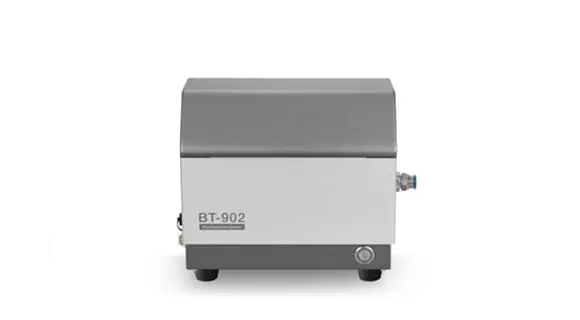
  • 乾式・湿式分散ユニットをシームレスに切り替え可能
  • 直感的なソフトウェアにより操作性が向上
  • ISO 13320、21 CFR Part 11、USP <429>、ISO 13322-2に準拠
ビデオ

How to Install and Operate Bettersizer 2600 Video play

Bettersizer 2600 | Laser Diffraction Particle Size Analyzer (Wet & Dry) Video stop

Snippet - How to Measure Particle Size of Coffee Powder Video stop

Ask an Expert! Introducing Bettersizer 2600 Video stop

A Brief Introduction to Laser Diffraction | Fundamentals of Bettersizer 2600 Video stop

Bettersizer 2600 Demonstration with Corundum (Al2O3) sample Video stop

How to Measure Particle Size of Cosmetics Video stop

How to Measure Particle Size of Coffee Powder Video stop

Bettersizer 2600 Overview | Laser Diffraction Particle Size Analyzer (Dry & Wet Dispersions) Video stop

概要

Citations

  • Bettersizer 2600

    Functional redundancy as an indicator for evaluating functional diversity of macrobenthos under the mussel raft farm near Gouqi Island

    DOI: 10.1016/j.aquaculture.2023.740024 Read Article Go logo
    Zhejiang Ocean University | 2024
    Biological traits analysis (BTA) helps to evaluate the effects of different environmental variables on the traits-based functional composition of macrobenthos. However, research on functional traits of macrobenthos under mussel farming is limited. We investigated the spatial and temporal response of the benthic system in terms of taxonomic and functional diversity to environmental variables of farming and natural stressors resulting from suspended mussel farming near Gouqi Island of eastern China Sea. The functional traits of macrobenthic assemblages under mussel farming were characterized by “medium adult body size”, “vermiform body form”, “high flexibility”, “infauna”, “semi-motile”, “gonochoristic”, “surface deposit-feeders”, “carnivores”, “semi-motile burrowers”, and “tube-dwellers”. Functional redundancy was stable in response to mussel farming stresses among seasons, whereas species diversity showed efficient to evaluate natural variables. Functional diversity was significantly affected by farming stressors rather than natural variables, Further analysis using multivariate methods together with continuous monitoring were highlighted to evaluate the impacts of mussel farming. Our results reinforce the importance of macrobenthic species and functional traits analysis to evaluate human stresses driven impacts in offshore ecosystems. By analysing the environmental variables with different sources, independently, we concluded the main effects of human pressures on macrobenthic community. Such distinction could be particularly effective to isolate variable environmental descriptors and evaluate their effects on functional diversity, making the current approach promising for the evaluation of ecological effects of anthropogenic stressors in aquaculture areas.
  • Bettersizer 2600

    Degradation characteristics and utilization strategies of a covalent bonded resin-based solid amine during capturing CO2 from flue gas

    DOI: 10.1016/j.seppur.2023.125621 Read Article Go logo
    China University of Petroleum | 2024

    In this study, various types of degradation as well as attrition which are possibly encountered in a circulating fluidized bed temperature swing adsorption (CFB-TSA) process, were conducted experimentally to evaluate the stability of a resin-based solid amine sorbent. Other characterizations methods, such as elemental analysis (EA), Fourier transform infrared spectroscopy (FTIR) etc. were applied to further reveal the degradation mechanisms. The results showed that thermal degradation occurs from 140–160 °C due to the decomposition of amine group. The CO2-induced degradation occurs from a higher temperature of 160–180 °C accompanied by the production of urea. Hydrothermal stability is good below 130 °C, but the ionic impurities in steam crystalized on particle surface can accelerate the degradation. Oxidative degradation is the most harmful, which starts at a lower temperature of 70–80 °C with the formation of aldehyde. The existence of H2O in atmosphere can alleviate the oxidative and CO2-induced degradations. The employed sorbent has a very low attrition index of 0.05, which is 1–2 orders lower than typical commercial fluidized bed catalysts. Based on the results of stability evaluation, some design suggestions for proper utilization of this sorbent or other similar resin-based sorbents have been provided in an industrial CFB-TSA process.

  • Bettersizer 2600

    De-branching of starch molecules enhanced the complexation with chitosan and its potential utilization for delivering hydrophobic compounds

    DOI: 10.1016/j.foodhyd.2023.109498 Read Article Go logo
    Shihezi University | 2024
    The current study aimed to prepare the complexes between debranched-waxy corn starch and chitosan polymers (DBS-CS), and then investigated their corresponding structural characteristics, rheological property and potent application in Pickering emulsion. The results indicated that the existence of chitosan significantly inhibited starch short-range molecular rearrangement for all DBS-CS samples, which was manipulated by both debranching treatment and chitosan content. Interestingly, this is the first study to reveal that the outstanding peak at 1.8 ppm in 1H NMR spectrum for sample DBS-CS was gradually shifted towards a lower-field region following an increased chitosan content. Moreover, the debranching treatment shifted the crystallinity pattern from A-type to B-type and the relative crystallinity of DBS-CS decreased gradually with the increased content of CS. All samples had a pseudoplastic fluid and shear-thinning behavior with an enhanced shear resistance following the complexation. The DBS-CS was applied in a Pickering emulsion for showing a greater emulsifying stability and a lower gel strength than native NS-CS prepared emulsion. Importantly, the encapsulation ability of curcumin in the DBS-CS emulsion was significantly improved, followed by an increase of 15.45% for its corresponding bioavailability compared to the control. Therefore, this study might highlight a potential carrier for delivering the bioactive substances in a green pattern.
  • Bettersizer 2600

    Heat-induced aggregation behavior of wheat gluten after adding citrus pectin with different esterification degree

    DOI: 10.1016/j.foodhyd.2023.109420 Read Article Go logo
    Gansu Agricultural University | 2024
    Wheat gluten aggregation during heat treatment is beneficial to the final quality of gluten-based products. Exogenous pectin can affect gluten aggregation. However, the effect of pectin with different degrees of esterification on the heat-induced aggregation behavior of gluten and its possible mechanism are still unclear. Thus, the heat-induced aggregation behavior of gluten after adding pectin with different esterification degree was studied in this study. When the temperature was raised from 25 °C to 95 °C, pectin affected gluten aggregation and was related to the degree of esterification. Specifically, the results of rheological properties and particle size indicated that low-ester pectin improved the viscoelasticity of gluten and promoted gluten aggregation. Thermal properties revealed that enthalpy of gluten added with low-ester pectin (37%) increased from 92.96 J/g to 95.40 J/g during heating process. Structurally, the fluorescence intensity and surface hydrophobicity of gluten added with low-ester pectin (37%) were lower than those added with high-ester pectin (73%). In addition, low-ester pectin (37%) significantly increased the disulfide bond content (from 15.31 μmol/g to 18.06 μmol/g) and maintained β-sheet content of gluten compared with gluten alone at 95 °C, indicating that low-ester pectin was more likely to induce gluten aggregation. However, scanning electron microscope showed that the gluten added with low-ester pectin (46%) exhibited a denser network structure at 95 °C than that added with low-ester pectin (37%). These results will provide a theoretical base for the regulation of gluten aggregation and the quality of gluten-based products by pectin with different esterification degree.
Page 1 of 41
  • 1
  • 2
  • 3
  • 4
  • 5
  • 6
  • 41
Go to

厳選されたリソース

その他の資料

お客様のお声

正確なAPIサイズ分析

ベターサイザー2600は、湿式と乾式の2つの機能を備え、APIを効率的に合理化するサイズ分析の画期的な製品です。この装置は一貫した結果を提供し、ラボの時間を節約しながら処方を促進します。さらに、Bettersizeのアフターサービスとアプリケーションサポートは、シームレスな操作を保証します。一流のサイジング結果を必要とする製薬ラボには、この装置を強くお勧めします。

Tauseef Khan

BS 2600の堅牢な性能で生産性を向上!

ベターサイザー2600レーザー回折式グラニュロメーターを導入したことで、乾燥分散液と液体分散液の両方で粒度分析が可能になり、分析能力が向上したことを嬉しく思います。したがって、製薬、化粧品、栄養補助食品分野における製剤ソリューションの開発能力を向上させることができると確信しています。適切なツールの選択と設置時のサポートに感謝します。

Andrea Bonda

時間節約装置

スプレードライ製品の粒子径を乾式で測定するための簡単な装置。

Andrea Foglio Bonda

start end
SelectScience

関連粒度分布測定機

  • Bettersizer S3 Plus

    Bettersizer S3 Plus

    粒子径・粒子形状分析装置

    測定範囲:0.01~3,500μm(レーザ回折・散乱法)

    測定範囲:2~3,500μm(動的画像解析法)

  • Bettersizer ST

    Bettersizer ST

    品質管理向け一体型モデル

    湿式分散

    測定範囲:0.1〜1,000μm

    再現性誤差:≤1%

  • BeScan Lab stability analyzer

    BeScan Lab

    分散安定性評価装置

    完全非破壊測定

    最大95%v/vの高濃度分散体の評価が可能

    80℃まで加熱温調機能を搭載

  • BeNano 180 Zeta Pro

    BeNanoシリーズ

    ナノ粒子径・ゼータ電位測定装置

    搭載技術:DLS(動的光散乱法)、ELS(電気泳動光散乱法)、SLS(静的光散乱法)